
Research Progress
CIAC's Independently Developed AI-Electrochemist Achieves Major Technological Breakthrough
Recently, the research team led by Researcher Zhou Min at the Changchun Institute of Applied Chemistry (CIAC), Chinese Academy of Sciences, has made significant progress in the field of AI-empowered new energy and new materials R&D with their independently developed AI-Electrochemist (Smart Laboratory for New Energy and New Materials), successfully achieving full-process intelligent integration.
The laboratory focuses on frontier research in new energy and new materials, deeply integrating artificial intelligence technology with high-throughput experimental methods, overcoming the low efficiency and screening challenges in traditional materials R&D. The laboratory has achieved a daily R&D capacity of up to 200 material groups, compressing experimental tasks that would originally require 50 years into less than one week. The laboratory has independently designed 12 core material workstations, covering original high-throughput material design and optimization, synthesis and preparation, screening and prediction modules. It has also innovatively developed an AGV robot intelligent operation system and task scheduling platform, forming a fully intelligent closed-loop R&D system spanning material design, synthesis, preparation, characterization, screening, and prediction.
In terms of application, the AI-Electrochemist has achieved multiple innovative breakthroughs in electrocatalysis, photoelectrocatalysis, batteries, and electrolytes, providing creative solutions for new energy and new materials research while significantly improving the efficiency of research outcomes translation. These results have served a national AI major project and were featured in a special report by CCTV's "New Quality Productive Forces" program, receiving high recognition from leaders at the Ministry of Science and Technology, the National Natural Science Foundation of China, and the Jilin Provincial and Changchun Municipal Party Committees. Additionally, the laboratory's advanced high-throughput material synthesis workstation has been widely adopted by over 100 research institutions across China.
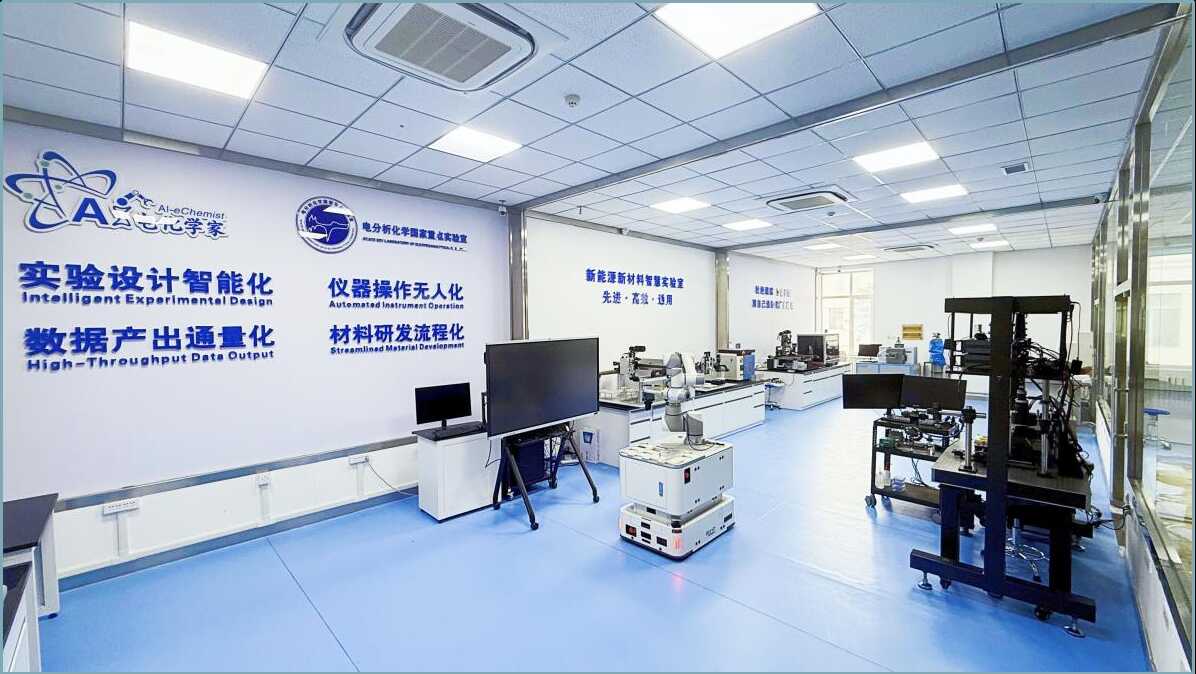
AI-Electrochemist
Meanwhile, the team has also achieved important breakthroughs in cutting-edge electrochemical characterization technology, successfully developing an ultra-resolution electrochemical microscopy system (MT-SRECM100-600, with six flagship models). The system innovatively integrates core components including a femtoamp-level electrochemical workstation, a microsecond-level patch-clamp amplifier, a nano-piezoelectric module, and an electrode probe preparation system. It has overcome key technical challenges, supports multi-mode high-resolution imaging, and provides stable intelligent environmental control through the integration of the nano-piezoelectric module with nano-electrode probes. The system is compatible with multimodal techniques including optical and Raman spectroscopy. These technological innovations have restructured the electrochemical microscopy technology framework, filling the domestic gap in this field and providing leading research tools for scientists in China. The equipment has been deployed at the University of Science and Technology of China, Xiamen University, the Institute of Process Engineering (CAS), the University of Science and Technology Beijing, and other institutions, contributing to the publication of multiple papers in internationally renowned journals including Science, Nature Communications, JACS, Angewandte Chemie International Edition, and Nano Letters.
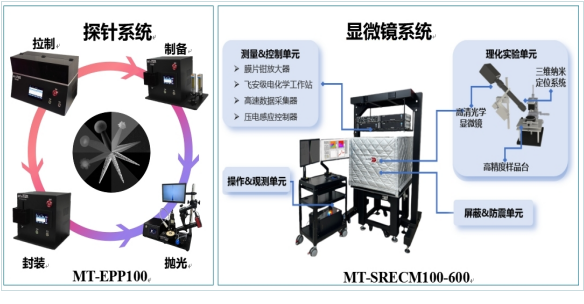
Ultra-resolution Electrochemical Lab

 Address: No. 5625 Renmin Street Changchun City Jilin Province P.R. China
 Tel: 86-0431-85687300