
Events
Chinese Academy of Sciences Holds 2026 Annual Work Conference
From January 28 to 29, the Chinese Academy of Sciences (CAS) held its 2026 Annual Work Conference in Beijing. Hou Jianguo, President of CAS and Secretary of the CPC Leadership Group, delivered a work report entitled "Shouldering the Mission of the Main Force of National Strategic Science and Technology Strength and Embarking on a New Journey Toward Building a Science and Technology Powerhouse." Wu Zhaohui, Vice President of CAS and Deputy Secretary of the CPC Leadership Group, and Zhou Qi, Vice President and member of the CPC Leadership Group, presided over the conference in alternating sessions. All CAS leadership and some retired senior leaders attended the conference. A responsible comrade from the Science and Technology Audit Bureau of the National Audit Office was invited to attend.
The conference was convened at a critical juncture — the opening year of the "15th Five-Year Plan" period — when CAS is accelerating its push toward the commanding heights of science and technology and launching a decisive sprint toward fully achieving the "Four Pioneers" objectives. Guided by Xi Jinping Thought on Socialism with Chinese Characteristics for a New Era, the conference deeply studied and implemented the spirit of the 20th CPC National Congress, all plenary sessions of the 20th CPC Central Committee, and the Central Economic Work Conference. It planned strategies and measures to strengthen the organizational and operational capacity of the main force of national strategic science and technology, accelerate the seizure of the commanding heights of science and technology, summarize the work of the "14th Five-Year Plan" period and 2025, and deploy key tasks for 2026.
The conference systematically reviewed the achievements of CAS's reform, innovation, and development during the "14th Five-Year Plan" period. Over the past five years, the entire academy has conscientiously studied and implemented General Secretary Xi Jinping's important speeches, instructions, and directives, carried out the decisions and deployments of the CPC Central Committee and the State Council, anchored the goals of "Four Pioneers" and "Two Accelerations and One Effort," firmly upheld its mission as the main force of national strategic science and technology, and focused on the core task of seizing the commanding heights of science and technology. Starting from "defining positioning" and "setting targets," and proceeding through "determining tasks" and "formulating policies," CAS has promoted widespread awareness of its mission, significantly enhanced its capacity to organize major national science and technology missions, steadily improved its function as a source of original innovation, made solid progress in building a national innovation talent highland, achieved important progress in constructing a new pattern of collaborative and open cooperation, and obtained a batch of critical, original, and leading scientific and technological achievements oriented toward "the four imperatives." Reform, innovation, and development have reached new levels and achieved new breakthroughs. In 2025, the entire academy, adhering to a principle of action-oriented effort, achieved a successful conclusion to the "14th Five-Year Plan," laying a solid foundation for fully achieving the "Four Pioneers" during the "15th Five-Year Plan" period.
The conference noted that the CPC Central Committee has placed scientific and technological innovation at the core of national development and set higher, more urgent requirements for science and technology work. As the main force of national strategic science and technology, CAS should take the lead in achieving high-level scientific and technological self-reliance and building a science and technology powerhouse. It should propose and deliver high-quality major national science and technology missions oriented toward "the four imperatives," continuously achieve critical, original, and leading achievements, and play a leading role in original innovation and key core technology research. It should continuously provide high-level scientific and technological supply, foster new quality productive forces, and offer strong support for national strategic needs and high-quality economic and social development. It should represent the nation in key science and technology areas and at international scientific frontiers, engage in and win high-level international competition, and build substantial international influence and leadership.
The conference emphasized that strengthening the organizational and operational capacity of the main force of national strategic science and technology is a major and urgent task for the current and future period. It is necessary to continue deepening reform of institutional mechanisms and better organize and concentrate advantageous forces. Party building leadership and ideological education should be strengthened, the spirit of scientists vigorously promoted, and a powerful synergy for seizing the commanding heights of science and technology consolidated. Academy-level coordination and management should be improved, with stronger overall planning of layout, major tasks, and policy resources, to better leverage systematic and institutional advantages. Institute management should be standardized and strengthened, an academic-respecting institutional culture built, internal control mechanisms and organizational discipline enhanced, and the governance capacity of research institutes continuously improved. Efforts should focus on strengthening the cadre leadership team, emphasizing selection of the best, enhancing training, enabling upward and downward mobility, and providing organizational guarantees for overcoming difficulties.
The conference made comprehensive deployments for 2026 across multiple areas: research and formulation of the "15th Five-Year Plan," securing and implementing major science and technology missions, mission-driven institutionalized basic research, AI-driven transformation of research paradigms and management, strengthening of scientific and technological infrastructure, deepening reform of research institutes, integrated advancement of education, science and technology, and talent development, high-level opening-up and cooperation, coordinating development and security, and strengthening the Party's overall leadership over science and technology work.
At the conference, Wu Zhaohui delivered a special report on Party building and talent work progress and 2026 priorities, and presented an overview of the "15th Five-Year Plan" formulation. Sun Yegang delivered a special report on deeply implementing the spirit of the Fifth Plenary Session of the 20th Central Commission for Discipline Inspection and providing strong safeguards for the launch of the "15th Five-Year Plan." Zhou Qi reported on progress in basic research and key tasks during the "15th Five-Year Plan" period. Deputy Secretary-General Wen Ya reported on progress in key laboratory construction and the initiation of strategic pilot science and technology programs. The Major Science and Technology Projects Bureau reported on progress and landmark achievements in seizing the commanding heights of science and technology.
Delegates engaged in lively discussions around the conference theme, expressing their resolve to continue anchoring the "Four Pioneers" and "Two Accelerations and One Effort" goals, strengthening confidence, building momentum, and continuing the fight, to deliver high-quality implementation of the "15th Five-Year Plan," strengthen mission-driven institutionalized basic research, accelerate breakthroughs in key core technologies, strive to seize a batch of commanding heights in science and technology, work to build world-class research institutions, and aim to fully achieve the "Four Pioneers" goals at an early date.
In his concluding remarks, Hou Jianguo emphasized that 2026 is the first year of CAS's decisive sprint to accelerate the seizure of the commanding heights of science and technology and fully achieve the "Four Pioneers." The entire academy should unite more closely around the CPC Central Committee with Comrade Xi Jinping at its core, deeply appreciate the decisive significance of the "Two Establishments," strengthen the "Four Consciousnesses," uphold the "Four Confidence Principles," and achieve the "Two Safeguards." He called for strengthening confidence, advancing with courage, vigorously seizing the commanding heights of science and technology, and fully demonstrating the mission and responsibility of the main force of national strategic science and technology in the great journey toward high-level scientific and technological self-reliance and building a science and technology powerhouse, making new and greater contributions to the construction of a strong nation and the great rejuvenation of the Chinese nation.
The conference also presented the 2025 CAS Outstanding Science and Technology Achievement Award, Young Scientist Award, and International Science and Technology Cooperation Award, and commended advanced collectives, advanced workers, Person of the Year, and Team of the Year.
Heads of the Discipline Inspection and Supervision Group of the Central Commission for Discipline Inspection and the National Supervisory Commission stationed at CAS, principal heads of all CAS departments, and principal Party and administrative leaders of all CAS-affiliated institutions attended the conference.
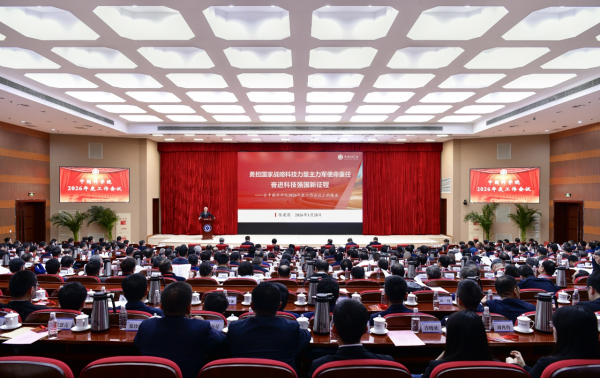
Figure 1. Scene of the 2026 Annual Work Conference of the Chinese Academy of Sciences.
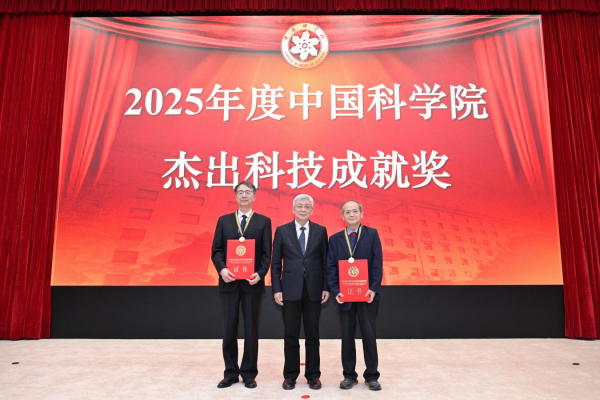
Figure 2. Hou Jianguo presents the 2025 CAS Outstanding Science and Technology Achievement Award (Individual Achievement) to Zhou Xiangyu and Ding Kang.

 Address: No. 5625 Renmin Street Changchun City Jilin Province P.R. China
 Tel: 86-0431-85687300