


Research Progress
Breakthrough in Proton Exchange Membrane Fuel Cell Technology
The Changchun Institute of Applied Chemistry, Chinese Academy of Sciences (CIAC, CAS) has achieved significant progress in the structural design of low-platinum cathode catalysts and their proton exchange membrane fuel cell (PEMFC) applications. The research team led by Xing Wei, Xiao Meiling, Liu Changpeng, and Liu Wei proposed a novel approach of chemical bond-regulated chemical potential bridging to address the issue of component migration and dissolution of Pt₃Co intermetallic compound cathode catalysts under high-potential cycling. They constructed a rare earth lanthanum (La)-doped ordered L1₂-Pt₃Co intermetallic compound catalyst system. The related research results were published in the prestigious international chemistry journal Journal of the American Chemical Society under the title "Lanthanum-Induced Quasi-Covalent Bonding and Chemical Potential Bridging in Pt₃Co Intermetallic Catalysts for Durable Fuel Cells."
The cathode oxygen reduction reaction (ORR) in PEMFCs exhibits sluggish kinetics, requiring cathode catalysts to maintain not only high activity but also structural and compositional stability under operating conditions such as repeated start-stop cycles and potential fluctuations. Ordered intermetallic compounds represented by Pt₃Co possess good intrinsic activity; however, transition metals such as cobalt, nickel, and iron may migrate to the surface and dissolve in electrochemical environments, causing activity degradation and voltage drop, which has become a critical factor limiting their long-term application.
To address these issues, the research team designed and synthesized rare earth lanthanum-doped L1₂-LaPt₃Co intermetallic compound nanocatalysts. The material employs a MOF-derived coordination strategy, using La ions as bridging nodes, and achieves alloy ordering and precise site construction through Pt/Co impregnation and controlled thermal treatment (Figure 1A). Benefiting from the electron-rich characteristics of La, it further supplies electrons to Pt and Co, strengthening Pt-La/Pt-Co interactions and providing a more stable electronic environment. The material showed no significant structural reconstruction or metal dissolution after durability testing, demonstrating excellent dissolution resistance. In-depth studies revealed that the introduction of La induces Pt-La quasi-covalent interactions within the particles and reduces the chemical potential difference at the core-shell interface, synergistically enhancing the energy barriers for metal migration/dissolution from both thermodynamic and kinetic perspectives (Figure 1B). This catalyst achieved outstanding performance and lifetime under low platinum loading in fuel cell devices, with a mass activity of 1.29 A·mg⁻¹Pt at 0.9 ViR-free at a cathode Pt loading of 0.10 mgPt cm⁻², significantly higher than commercial catalysts and exceeding the U.S. Department of Energy 2026 target (0.44 A·mg⁻¹Pt). The peak power density under H₂-air conditions reached 1.27 W cm⁻², with a mass power density normalized to cathode Pt loading of 6.35 W mg⁻¹_Pt. In terms of durability, the catalyst retained 87% of its mass activity after 30,000 cycles, with a voltage decay of only 12 mV at 0.8 A cm⁻², meeting and surpassing the U.S. DOE 2026 targets for activity retention and voltage decay (Figure 1C).
This study, through the introduction of rare earth elements that form strong interactions with platinum within intermetallic compounds, achieved synchronized regulation of bonding networks and chemical potential gradients, effectively suppressing metal migration and dissolution under harsh electrochemical conditions, providing a new material design pathway for constructing highly active and durable low-platinum fuel cell cathode catalysts.
The research results are published in Journal of the American Chemical Society:
https://pubs.acs.org/doi/10.1021/jacs.5c16692
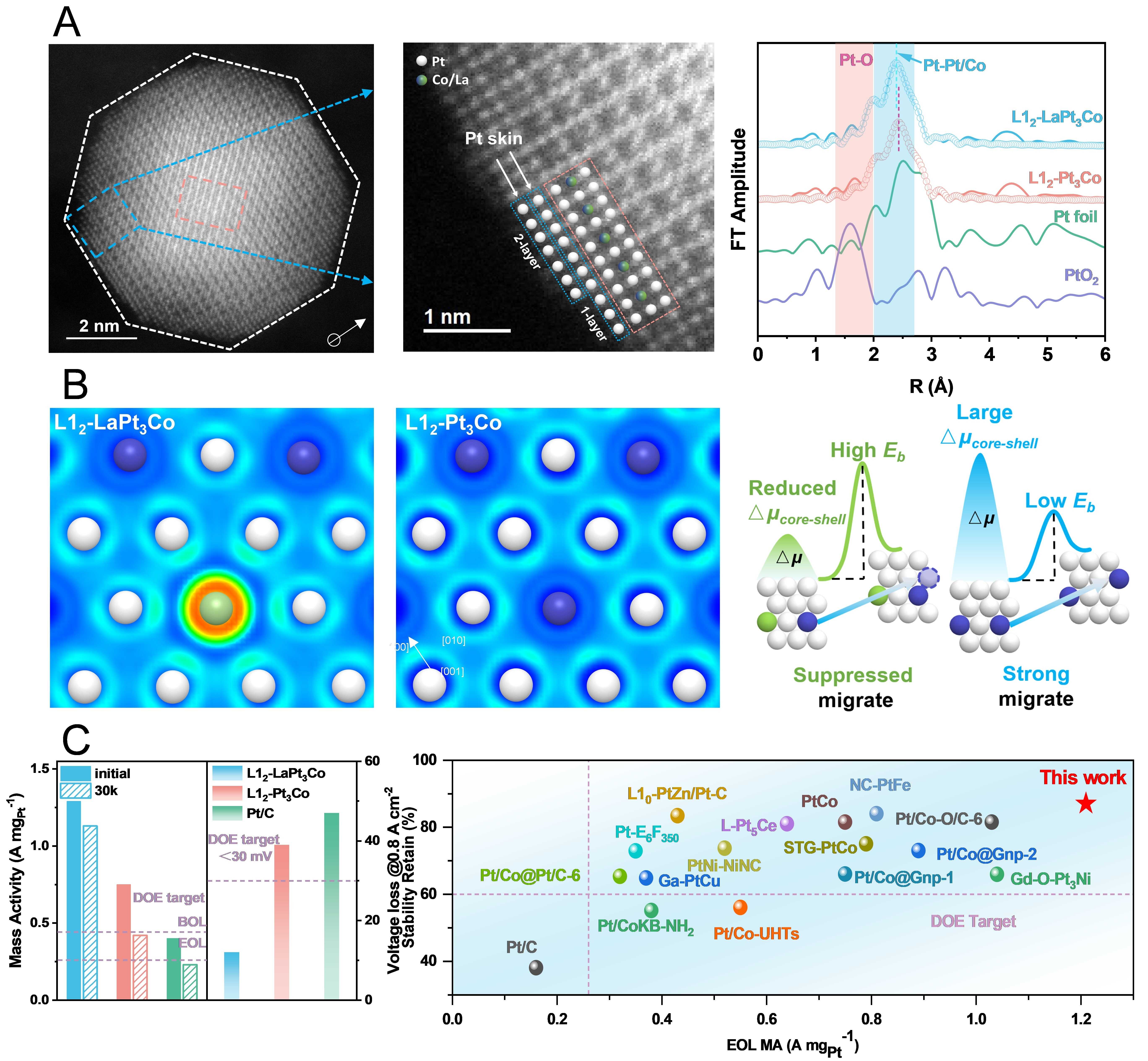
Figure 1. Schematic illustration of the synthesis strategy, structural characterization, and fuel cell performance and durability of La-doped L1₂-Pt₃Co intermetallic compound cathode catalysts.


 Address: No. 5625 Renmin Street Changchun City Jilin Province P.R. China
 Tel: 86-0431-85687300