


Research Progress
Breakthrough in Bioactive Poly(amino acid) Materials for Tumor Treatment
The Changchun Institute of Applied Chemistry, Chinese Academy of Sciences (CIAC, CAS) has achieved a significant breakthrough in the structural design of bioactive poly(amino acid) materials and their application in efficient tumor treatment. The research team led by Chen Xuesi and Ding Jianxun has successfully developed a novel bioactive poly(amino acid) material that specifically responds to the tumor microenvironment. This material can self-assemble into a three-dimensional cationic network structure in situ within tumor tissues and cells, efficiently inducing the formation of microvesicles in tumor cells and triggering a sustainable cascading bystander killing effect, providing an innovative strategy for tumor therapy. The related research results were published in the prestigious international chemistry journal Journal of the American Chemical Society under the title "A Tumor-Selective Self-Assembling Network of Poly(amino acid) Induces Cascading Bystander Cytotoxicity through Microvesicle Fission Amplification."
Intercellular signaling among tumor cells is a critical factor influencing tumor progression and treatment response. In recent years, extracellular vesicles represented by microvesicles have been confirmed as important carriers mediating intercellular communication and inducing bystander effects. However, existing treatment methods based on exogenous vesicle delivery commonly face challenges such as insufficient targeting, low intra-tumoral accumulation efficiency, and easy loss of biological activity. Therefore, how to induce the in situ generation of therapeutically functional vesicles within tumors has become a core scientific issue requiring urgent breakthroughs in this field.
To address this challenge, the research team designed and synthesized the bioactive poly(amino acid) material EG₄₅-D-K-D-pYA. This material, under the catalysis of alkaline phosphatase highly expressed in tumor tissues, undergoes phosphate ester bond cleavage, triggering a secondary structural transition from random coil to β-sheet (with β-sheet content increasing significantly from 40.6% to 83.3%), accompanied by a surface charge reversal (ζ potential changing from −4.95 mV to +25.0 mV). This synergistic change in structure and charge drives the material to self-assemble from dispersed nanoparticles into a continuous three-dimensional cationic network structure in situ (Figure 1A). This network structure first accumulates on tumor cell membranes, then acts on key organelles such as mitochondria and nuclei, causing a sharp increase in intracellular reactive oxygen species (ROS) levels, disrupting cellular homeostasis, and inducing tumor cell death. During this process, damaged tumor cells release a large number of microvesicles (Figure 1B). These microvesicles are rich in cationic poly(amino acid) materials as well as components from cell membranes, mitochondria, and nuclei, exhibiting high positive charge (ζ potential approximately +32.9 mV) and significant biological activity. In-depth studies revealed that microvesicles released from initially treated cells (P0 generation) can be selectively taken up by neighboring tumor cells, inducing the generation of new-generation microvesicles within them (Figure 1C), thereby achieving a cascading bystander killing effect spanning multiple generations within the tumor cell population. During intergenerational transmission, the surface positive charge of microvesicles gradually decreases, and their carried ROS levels peak at the P2 generation before declining. The corresponding bystander killing effect exhibits a unique nonlinear cascading attenuation pattern, with cell inhibition rates of approximately 53%, 29%, 36%, 25%, and 7% for P0 through P4 generations, respectively (Figure 1D), indicating that this process is synergistically regulated by ROS levels and surface charge. Furthermore, at the tumor tissue level, the in situ formed three-dimensional cationic network can mimic an extracellular matrix-like structure, forming a physical barrier that effectively inhibits tumor cell migration and metastasis, thereby achieving coordinated control of metastatic spread while suppressing primary tumor growth.
This study, through ingenious material design, achieved in situ construction of a therapeutic network within tumors and triggered a self-sustaining amplified bystander killing effect, providing new ideas and methods for developing efficient and intelligent tumor treatment strategies.
The research results are published in Journal of the American Chemical Society:
https://pubs.acs.org/doi/abs/10.1021/jacs.5c09790
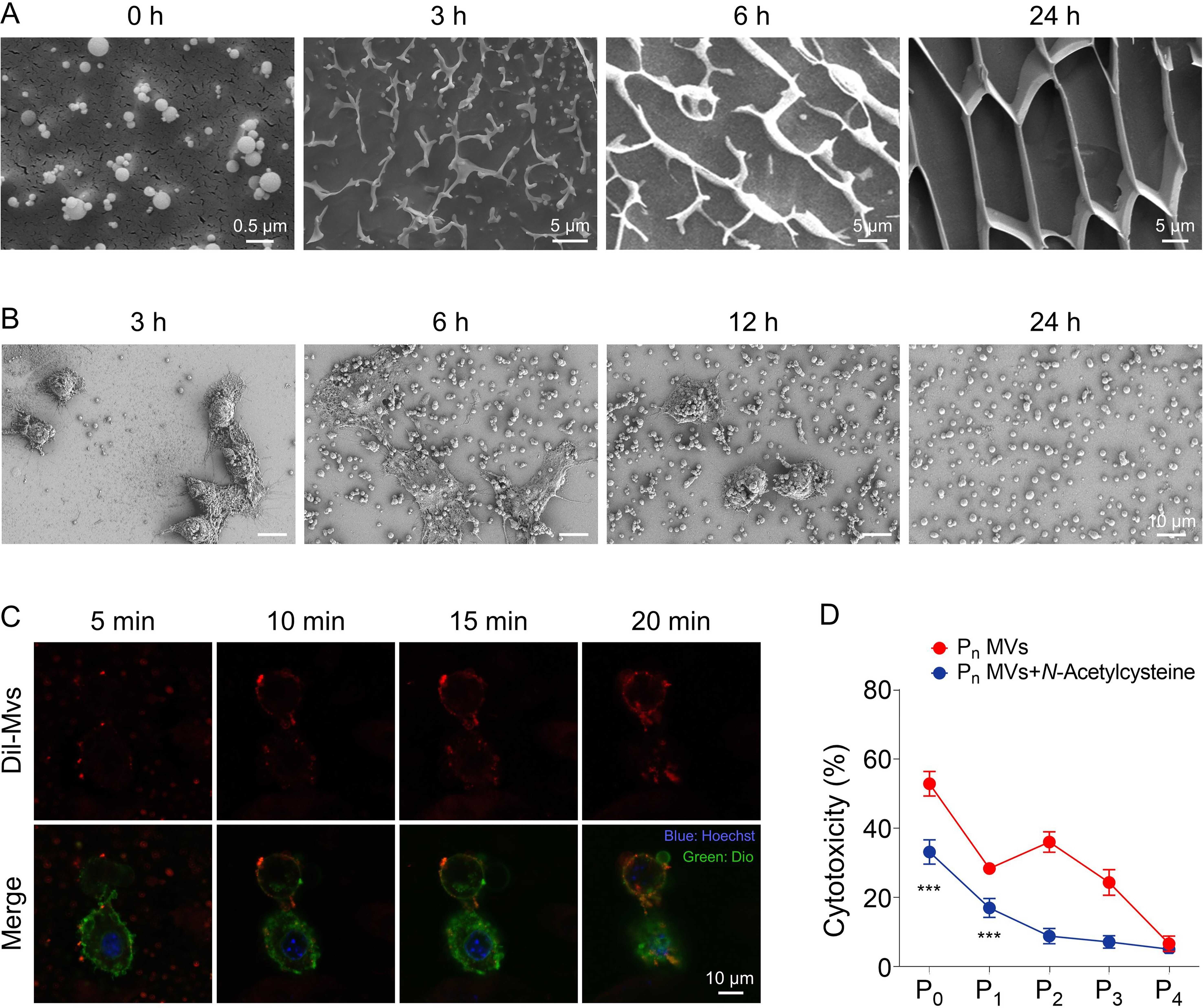
Figure 1. Self-assembly morphological evolution, microvesicle induction, and multigenerational bystander killing effect of the bioactive poly(amino acid) material EG₄₅-D-K-D-pYA.


 Address: No. 5625 Renmin Street Changchun City Jilin Province P.R. China
 Tel: 86-0431-85687300