


Research Progress
Progress in Precise Stereostructural Regulation of Polythioesters
The research team led by Researcher Tao Youhua at the Changchun Institute of Applied Chemistry, Chinese Academy of Sciences (CIAC, CAS) has achieved progress in the stereoselective polymerization of recyclable polythioesters. The team developed a covalent borane–thiourea bifunctional organocatalyst that enables efficient stereoretentive ring-opening polymerization of enantiopure dithiocarbonate monomers. This catalytic system, through synergistic regulation of monomer activation and growing chain-end reactivity, effectively suppresses racemization during polymerization, yielding polythioester materials with high molecular weight, high stereoregularity, and closed-loop recyclability, providing a new strategy for the molecular design of high-performance recyclable plastics. The related research results were published in the prestigious international journal Angewandte Chemie International Edition under the title "Covalent Borane–Thiourea Organocatalyst for Stereoselective Ring-Opening Polymerization."
The stereoregularity of polymers is a critical structural factor determining material crystallinity, thermal properties, and mechanical properties. For polythioester materials with closed-loop recycling potential, dithiocarbonate monomers are prone to racemization during ring-opening polymerization, leading to destruction of the polymer's stereostructure and making it difficult to obtain high-crystallinity, high-performance materials. Simultaneously, the strong coordination ability of sulfur atoms can easily cause metal catalyst deactivation. Therefore, developing catalytic systems that can simultaneously suppress racemization while maintaining high polymerization activity represents an important challenge in high-performance recyclable polythioester research.
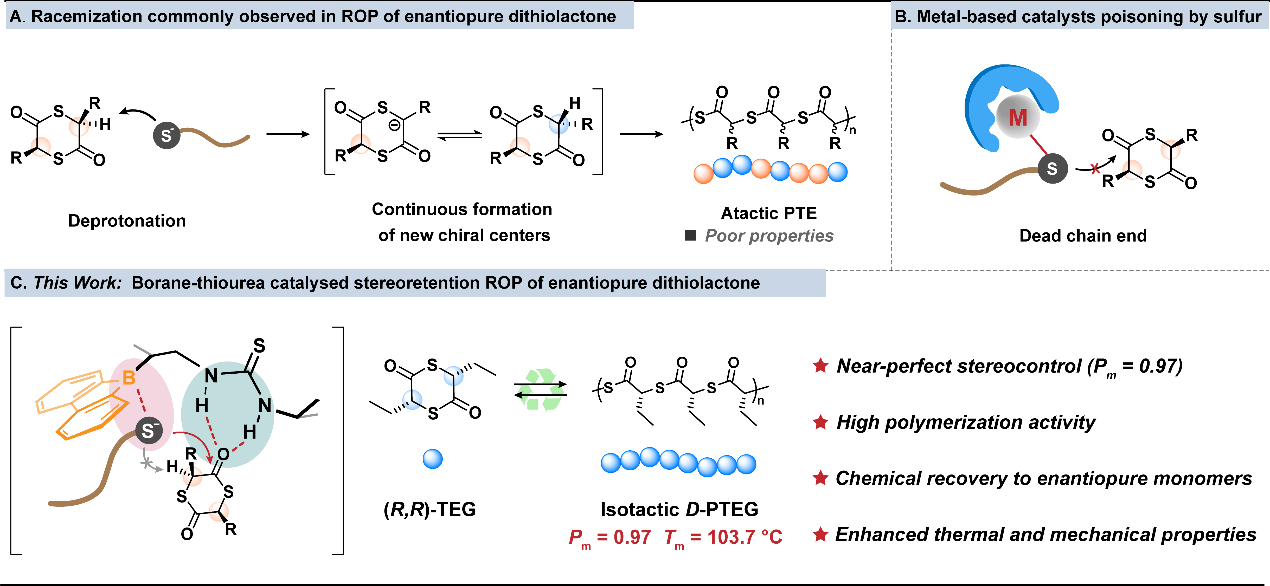
Figure 1. Covalent borane–thiourea bifunctional catalyst-mediated stereoretentive ring-opening polymerization of enantiopure dithiocarbonate monomers.
To address these issues, the research team designed a class of covalent borane–thiourea bifunctional organocatalysts. In this system, the thiourea unit activates dithiocarbonate monomers through hydrogen bonding, while the boron center regulates the reactivity of the growing chain-end thiolate anion to suppress racemization initiated by α-H deprotonation, achieving a synergistic catalytic mechanism of "monomer activation–chain-end regulation." Further studies revealed that upon introducing the more Lewis acidic 9-borafluorene structure, the catalytic system could more effectively stabilize the growing chain end and suppress side reactions. Theoretical calculations showed that this catalyst significantly increases the reaction energy barrier of the racemization pathway while the chain growth process maintains a low activation energy, thereby achieving simultaneous enhancement of polymerization activity and stereoretention capability.
Experimental results demonstrated that the optimized catalyst enables rapid polymerization of enantiopure dithiocarbonate monomers at room temperature, with polythioester molecular weights reaching up to 58.1 kDa and isotacticity P_m as high as 0.97, exhibiting near-perfect stereoretention capability. The highly stereoregular structure further endows the material with excellent thermal and mechanical properties. The resulting polythioesters can form semi-crystalline structures with a melting point of 103.7°C, tensile strength of 16.5 MPa, and elongation at break of 455.7%, with comprehensive performance comparable to commercial polyolefin materials. Meanwhile, the material retains the excellent chemical recycling characteristics of the dithiocarbonate system, capable of efficiently depolymerizing and recycling enantiopure monomers for repolymerization, achieving a "monomer–polymer–monomer" closed-loop cycle.
This study developed a covalent borane–thiourea bifunctional organocatalytic strategy, successfully resolving the long-standing racemization challenge in dithiocarbonate ring-opening polymerization. The research revealed a new mechanism for achieving stereoretentive polymerization through synergistic regulation of monomer activation and growing chain-end reactivity, providing new design concepts for organoboron-catalyzed regulation of polymer stereostructure, and opening new directions for developing next-generation sustainable plastics with both high performance and closed-loop recyclability.
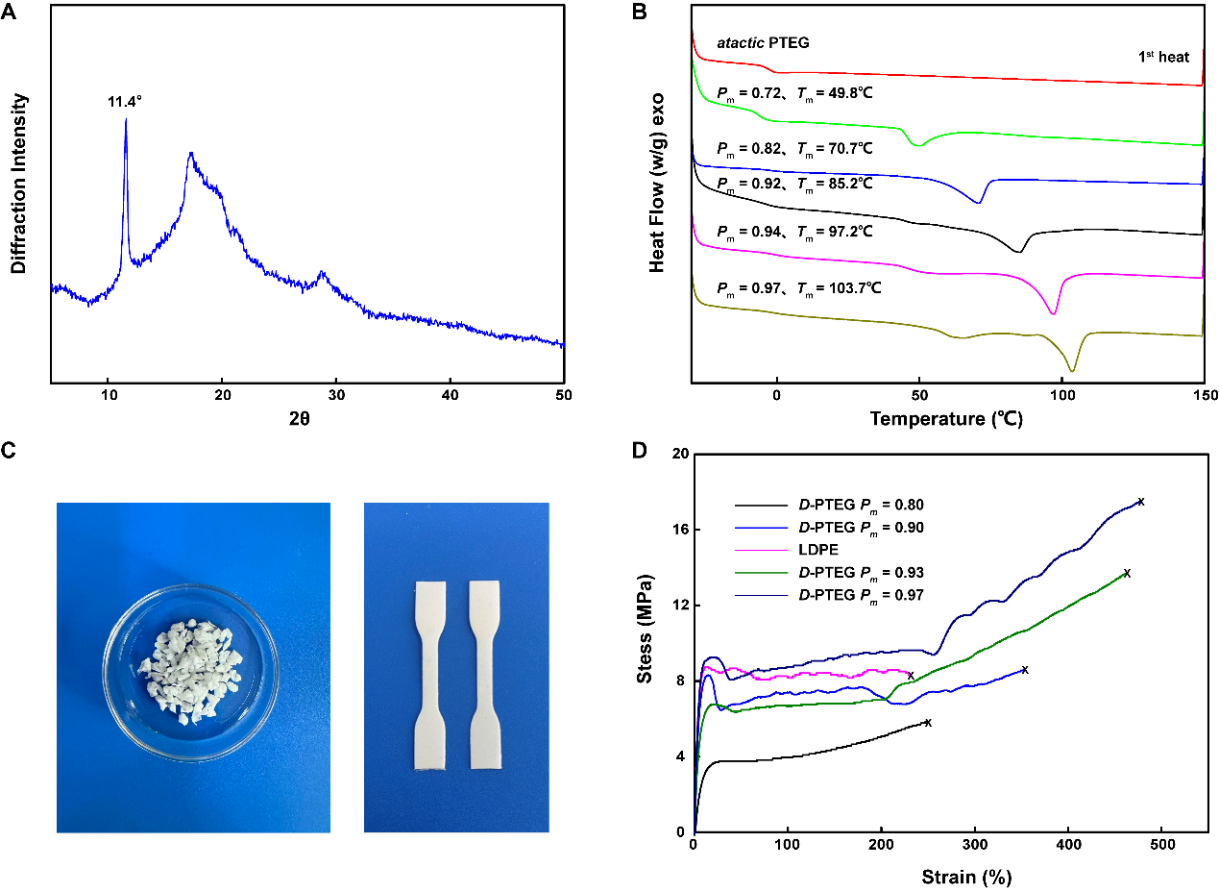
Figure 2. Effect of stereoregularity on thermal and mechanical properties of polythioesters.
The research results are published in Angewandte Chemie International Edition:
https://onlinelibrary.wiley.com/doi/abs/10.1002/ange.4158531


 Address: No. 5625 Renmin Street Changchun City Jilin Province P.R. China
 Tel: 86-0431-85687300