


Research Progress
Perspective Paper on Chemical Ecology and Convergent Evolution of Natural Hallucinogens Published in PNAS
The research team led by Wang Xiaohui at the Laboratory of Chemical Biology and Interdisciplinary Research, Changchun Institute of Applied Chemistry, Chinese Academy of Sciences (CIAC, CAS), was invited to publish a perspective paper titled "Chemical Ecology and Convergent Evolution of Natural Hallucinogens: From Ecological Defense to Conserved Neural Targets" in Proceedings of the National Academy of Sciences (PNAS). This paper systematically elaborates on the multiple independent origins, ecological functions, and evolutionary basis for acting on conserved neural targets of natural hallucinogens in plants, fungi, and animals, from multi-disciplinary perspectives including chemical ecology, comparative genomics, biosynthetic logic, and evolutionary biology.
For a long time, natural hallucinogens have primarily attracted attention due to their strong effects on human perception, mood, and cognition. Classic hallucinogens such as psilocybin, mescaline, N,N-dimethyltryptamine (DMT), and related natural products demonstrate important value in psychiatric treatment, neural plasticity regulation, and consciousness science research. However, from nature's own perspective, a more fundamental question remains unresolved: why have plants, fungi, and animals repeatedly evolved compounds that can strongly modulate animal nervous systems? What functions do these molecules serve in their native ecological environments? Why can they act on highly conserved neurotransmitter systems in consumers, including humans, at trace doses?
This article argues that natural hallucinogens are not accidental "chemical accidents" but should be understood within the framework of ecological interactions and co-evolution. Plants, fungi, and animals have repeatedly utilized limited metabolic building blocks through evolutionary history, producing structurally diverse psychoactive compounds through modular modifications including hydroxylation, methylation, phosphorylation, and prenylation. These compounds may participate in ecological processes such as predator defense, herbivore deterrence, symbiotic relationship regulation, cross-kingdom communication, and environmental stress response. Since the serotonergic system and other neuromodulatory pathways in animal nervous systems are highly conserved in evolution, natural hallucinogens can produce intense and selectively retained ecological effects by targeting these ancient and widely distributed neural system nodes.
The article first outlines the chemical ecological foundations of natural hallucinogens. In plants, peyote (Lophophora williamsii) is rich in the phenylethylamine compound mescaline, whose bitter taste, physiological activity, and high metabolic cost suggest potential defensive functions. In recent years, the biosynthetic pathway of mescaline from L-tyrosine has been gradually elucidated, providing a molecular basis for understanding how plants construct psychoactive metabolites. In fungi, psilocybin biosynthesis has become an important model for studying modular gene clusters and rapid chemical innovation. Psilocybin-producing fungi utilize biosynthetic modules composed of core enzymes including PsiD, PsiH, PsiM, and PsiK to convert tryptophan into psilocybin; comparative genomic studies further suggest that related gene clusters may spread across different fungal lineages through rearrangement and horizontal transfer.
Animals can also incorporate neuroactive small molecules into their defense systems. The Sonoran Desert toad (Incilius alvarius) parotoid gland secretions contain 5-MeO-DMT, bufotenin, and bufadienolide cardiotonic steroids, constituting a multi-component chemical defense system. The article proposes that bufadienolides may produce acute deterrence through rapid cardiovascular effects and emetic action, while tryptamine components may cause significant perceptual and orientational disruption, with both types of components together forming an intense and prolonged aversive experience that promotes learned avoidance by predators. Additionally, DMT-related metabolic and signaling clues exist in mammals, suggesting that endogenous psychoactive molecules may participate in stress response, cytoprotection, and neural plasticity regulation, though their physiological functions require further experimental confirmation.
At the biosynthetic level, the article notes that although natural hallucinogens are structurally diverse, they share a relatively limited metabolic "grammar." The shikimate pathway provides aromatic precursors such as tryptophan, tyrosine, and phenylalanine; the isoprenoid pathway provides terpenoid building blocks; and one-carbon units are primarily supplied by S-adenosyl-L-methionine. Across different biological kingdoms, repeatedly recruited enzymes include pyridoxal phosphate-dependent decarboxylases, cytochrome P450 hydroxylases, O- and N-methyltransferases, kinases, prenyltransferases, and enzyme systems involved in Pictet-Spengler condensation or non-ribosomal peptide synthesis. It is this shared modular biosynthetic logic that enables plants, fungi, and animals to repeatedly "invent" bioactive natural products in different ecological contexts.
The article further proposes from an evolutionary perspective that the multiple appearances of natural hallucinochemistry across fungi, plants, and animals represent a convergent evolutionary phenomenon driven by shared ecological pressures and conserved neural targets. The serotonergic system, particularly the 5-HT₂ₐ receptor, appeared early in animal evolution and is widely distributed across invertebrates and vertebrates. Sequence conservation, expression distribution, comparative pharmacology, and behavioral studies collectively suggest that disrupting serotonergic signaling may provide producer organisms with a broad-spectrum ecological lever: influencing predation, foraging, or symbiotic relationships by altering consumer feeding, locomotion, learning, avoidance, and orientation behaviors.
The article also emphasizes that current evidence regarding the ecological functions of natural hallucinogens still contains important gaps. Many hypotheses require joint validation through field ecology, genetics, behavioral studies, and chemical biology. In particular, in real ecosystems, whether specific hallucinogenic molecules directly alter specific consumer behaviors, whether they improve producer fitness, and whether they drive long-term co-evolution still requires testing through genetically defined consumer models, in situ chemical ecology experiments, and cross-species comparative studies. Therefore, this paper does not simply extrapolate human experience to nature but proposes a testable comprehensive theoretical framework.
The article also notes that natural hallucinogen research has important implications for conservation biology and sustainable use. With rising interest in hallucinogens for psychiatric treatment and neuroscience research, issues of wild resource collection, ecological destruction, and biocultural rights are becoming increasingly prominent. By elucidating biosynthetic pathways of natural hallucinogens and achieving sustainable production through synthetic biology, microbial fermentation, and pathway engineering, pressure on wild plant, fungal, and animal resources can be reduced. Meanwhile, related research should fully consider indigenous knowledge, biocultural equity, and ecosystem protection, avoiding simplistic commodification of natural products with complex cultural and ecological backgrounds.
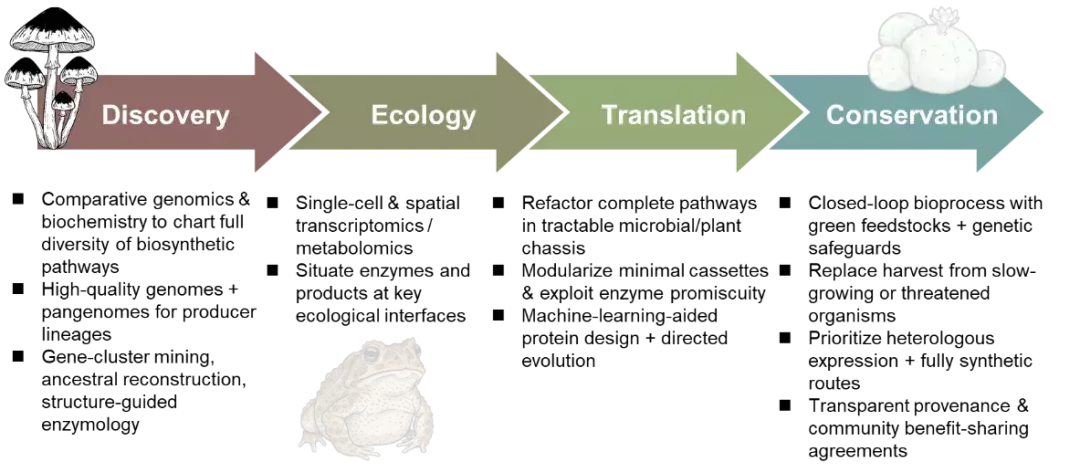
In summary, this article proposes that natural hallucinogens are products of the combined action of ecological selection, molecular constraints, and neurobiological opportunity. Their continued existence in nature reflects both the repeated exploitation of conserved neural targets by producer organisms and the complex interplay between modular biosynthesis, gene cluster mobility, enzyme family expansion, horizontal gene transfer, and pleiotropic ecological functions. This perspective provides a unified framework for understanding the ecological origins, evolutionary pathways, and biological functions of natural hallucinogens, and offers new theoretical foundations for the discovery, sustainable production, drug development, and ethical application of natural hallucinogens.
CIAC is a leading force in domestic hallucinogen research. In recent years, the team led by Researcher Wang Xiaohui has conducted systematic research on structural modification, receptor pharmacology, brain circuit mechanisms, neural plasticity regulation, and preclinical translation of hallucinogens, publishing more than thirty related papers in high-level journals including Nature, National Science Review, Molecular Psychiatry, and Brain, generating broad impact in the international academic community.


 Address: No. 5625 Renmin Street Changchun City Jilin Province P.R. China
 Tel: 86-0431-85687300