


Research Progress
Collaborative Study Reveals Novel Function of Bacteria-Derived Cyclic Peptides in Regulating Nematode Development and Reproduction
Recently, the research team led by Wang Xiaohui at the Laboratory of Chemical Biology and Interdisciplinary Research, Changchun Institute of Applied Chemistry, Chinese Academy of Sciences (CIAC, CAS), in collaboration with Fudan University and other institutions, discovered a daropeptide-like natural product named aphotorhaptin A derived from symbiotic bacteria of entomopathogenic nematodes, and revealed its ability to regulate nematode development, reproduction, and lifespan at low nanomolar concentrations. The related research results were published in Proceedings of the National Academy of Sciences (PNAS) under the title "An N-Acetylated Daropeptide Modulates Nematode Development."
Photorhabdus bacteria form obligate symbiotic relationships with entomopathogenic nematodes of the genus Heterorhabditis, jointly infecting insect hosts. In this complex "bacteria-nematode-insect" tripartite ecological system, natural small molecules produced by bacteria not only participate in suppressing competing microorganisms and insect immunity but may also serve as cross-species chemical signals regulating the physiology of symbiotic nematodes. However, the known related signaling molecules remain very limited. The collaborative team discovered aphotorhaptin A from Photorhabdus asymbiotica. This molecule belongs to ribosomally synthesized and post-translationally modified peptides (RiPPs), featuring ether bond crosslinks between aromatic amino acids and N-terminal acetylation modification. Studies have shown that N-terminal acetylation enhances the metabolic stability of the hexapeptide backbone; the related acetyltransferase PasC exhibits broad substrate adaptability, accepting different acyl donors and various peptide substrates, providing new tools for enzymatic modification of peptide natural products. Unlike the antimicrobial daropeptides, aphotorhaptin A did not show significant antimicrobial activity under the tested conditions, suggesting it may fulfill different ecological functions.
To clarify the biological function of this molecule, the researchers established a synchronized development evaluation system using the model organism Caenorhabditis elegans. Results showed that 30 nM aphotorhaptin A significantly promoted the L3-to-L4 developmental transition. At 48 hours post-treatment, the proportion of nematodes completing the L3-L4 transition increased by approximately 29% compared to controls; when the concentration was increased to 150 nM, this proportion increased by approximately 40%, indicating that aphotorhaptin A exhibits significant biological activity at low nanomolar concentrations. Further structure-activity comparison revealed that the non-acetylated pentapeptide, the N-terminally unmodified hexapeptide intermediate, the linear peptide without ether bond crosslinks, and derivatives carrying longer hexanoyl groups all failed to exhibit the same effect. This demonstrates that the N-terminal acetyl group and ether bond crosslink together constitute the structural basis necessary for aphotorhaptin A to regulate nematode development.
Beyond promoting larval development, aphotorhaptin A also significantly altered nematode reproductive and lifespan phenotypes. Researchers counted embryos within a defined early reproductive window and found that 30 nM aphotorhaptin A increased embryonic production in the first 36 hours by approximately 60%, suggesting the molecule promotes early reproduction in nematodes. Simultaneously, aphotorhaptin A shortened the average nematode lifespan by approximately 2.2 days. The concurrent appearance of accelerated development, increased early reproduction, and shortened lifespan suggests the molecule may alter resource allocation between growth, reproduction, and long-term survival in nematodes. This phenotype carries potential ecological significance. For entomopathogenic nematodes symbiotic with bacteria, rapidly completing development and reproduction within the insect host may benefit population expansion and entry into the next infection cycle. Therefore, aphotorhaptin A may not be a traditional toxin or antibiotic but rather a class of cross-species chemical signal produced by symbiotic bacteria to regulate nematode life history.
DAF-16 is an important transcription factor in C. elegans regulating development, metabolism, stress response, and lifespan, and serves as a core node of the insulin/insulin-like growth factor signaling pathway. The research team found that in wild-type nematodes, aphotorhaptin A significantly promoted L3-L4 development; whereas in daf-16 mutant nematodes, this promoting effect completely disappeared. This result indicates that aphotorhaptin A's regulation of nematode development depends on DAF-16-related signaling pathways. Since DAF-16 and its related regulatory networks are highly conserved across nematode species, this finding provides mechanistic clues for understanding the role of aphotorhaptin A in the natural "Photorhabdus–entomopathogenic nematode" symbiotic system. Its direct molecular target and whether it regulates DAF-16 through metabolism, nutrient sensing, or stress signaling require further investigation.
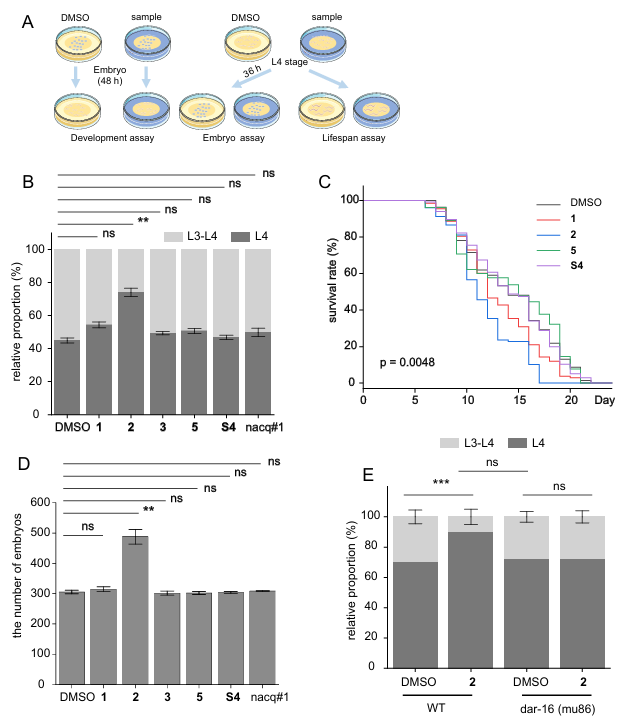
Figure 1. Nematode activity and DAF-16-dependent mechanism of aphotorhaptin A (Compound 2) and its biosynthetic intermediates.
This study reveals that ribosomally derived peptide natural products from bacteria, beyond possessing antimicrobial activity, can also serve as cross-species signaling molecules that directly regulate animal development, reproduction, and lifespan. Aphotorhaptin A connects bacterial natural product biosynthesis with nematode life history regulation, expanding our understanding of the biological functions of ribosomally synthesized and post-translationally modified peptides, and providing new molecular paradigms for studying chemical communication in microbe-animal symbiotic systems.
C. elegans, with its short life cycle, clear genetic background, rich mutant resources, and easily quantifiable development, behavior, reproduction, and lifespan phenotypes, serves as an important model organism for drug mechanism research and phenotypic drug screening. In recent years, the team led by Researcher Wang Xiaohui has established a relatively systematic C. elegans research platform, forming a technical system encompassing synchronized culture, development and reproduction analysis, lifespan and healthspan evaluation, movement and neural behavior detection, disease model construction, and genetic mechanism verification. this platform, more than ten related achievements have been published in journals including Advanced Science, Journal of Hazardous Materials, and FASEB Journal. This research further demonstrates the unique value of the model organism C. elegans in cross-species chemical signal research.
Ma Zeze from Jiangxi Normal University/Fudan University and Li Ruwei from CIAC are co-first authors of the paper. Wang Xiaohui's research team participated in research design and was responsible for C. elegans development, reproduction, lifespan, and DAF-16 genetic mechanism studies.


 Address: No. 5625 Renmin Street Changchun City Jilin Province P.R. China
 Tel: 86-0431-85687300