


Research Progress
Changchun Institute of Applied Chemistry Makes Progress in Extremozyme-Inspired Catalytic Epoxide Polymerization
A research team led by Professor Wang Xianhong and Professor Liu Shunjie from the Changchun Institute of Applied Chemistry (CIAC), Chinese Academy of Sciences, has made significant progress in the field of extremozyme-inspired catalytic epoxide polymerization. Inspired by the "double-trimer" hierarchical structure of hyperthermophilic glutamate dehydrogenase, the researchers constructed an "extremozyme-inspired" hexanuclear aluminum porphyrin catalyst. This catalyst achieved record-breaking catalytic activity in both propylene oxide homopolymerization and its copolymerization with phthalic anhydride and carbon dioxide. Notably, it can produce high-molecular-weight polymers at ppm or even sub-ppm aluminum loading levels, providing a new strategy for designing high-performance multinuclear polymerization catalysts. The related findings were published in the Journal of the American Chemical Society under the title "Extremozymes-Inspired Catalyst for Epoxide-Based Polymerization."
Natural enzymes rely on precisely arranged active sites and confined pockets to achieve highly efficient and selective transformations, serving as an important inspiration for artificial catalyst design. However, traditional biomimetic designs mostly use conventional enzymes adapted to mild environments as templates, while industrial polymerization typically requires operation at high temperatures, high pressures, and extremely low catalyst loadings. This mismatch has limited performance breakthroughs in biomimetic catalysts. Among these, epoxide homopolymerization and its copolymerization with anhydrides and carbon dioxide represent important pathways for preparing polyethers, polyesters, and CO₂-based polycarbonates. However, such reactions have long faced the challenge of simultaneously achieving high activity, low catalyst usage, and high molecular weight.
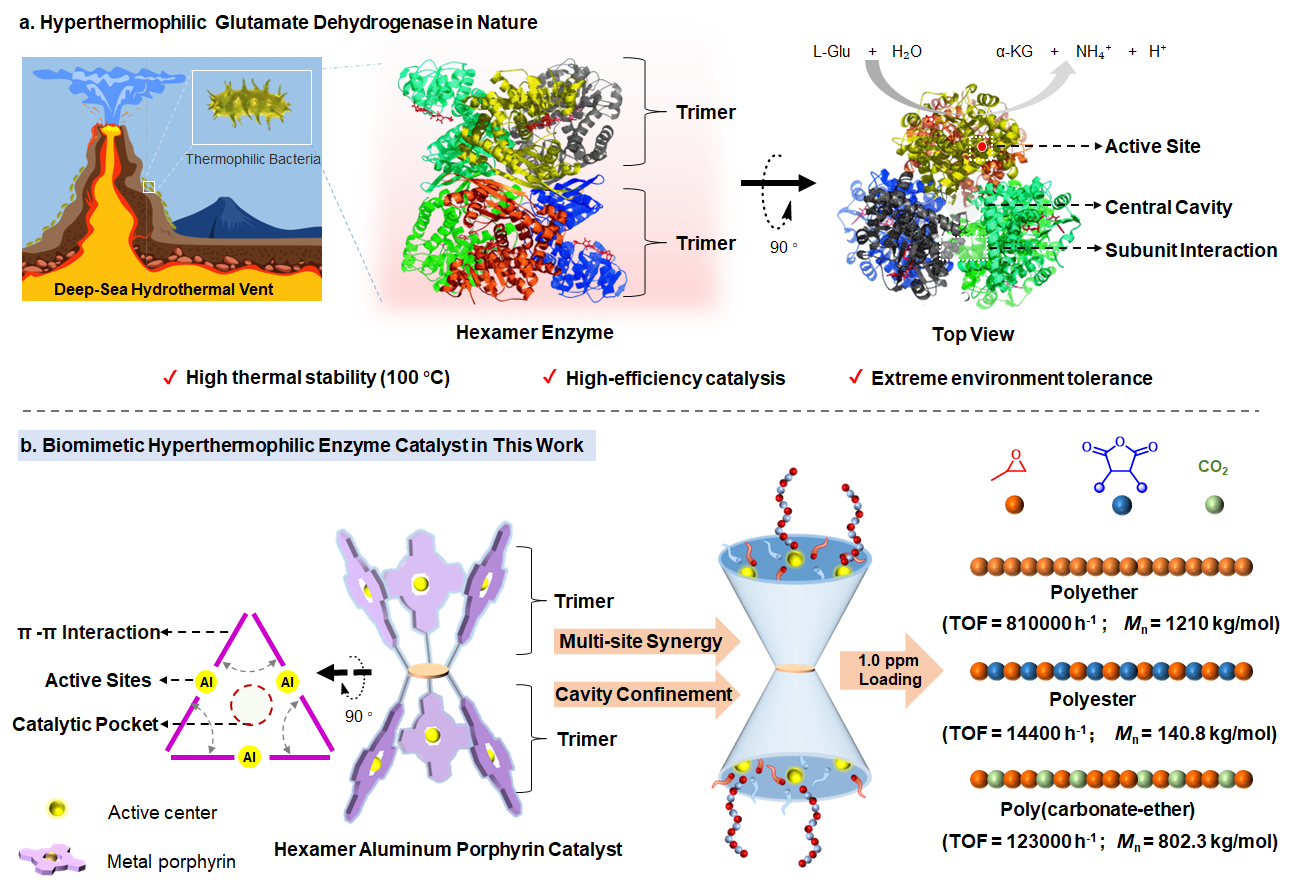
Figure 1. Design of hexanuclear aluminum porphyrin catalyst inspired by the "double-trimer" hierarchical structure of extremozymes
The researchers noted that hyperthermophilic glutamate dehydrogenase (GDH), derived from deep-sea hydrothermal vents, can maintain activity at temperatures exceeding 100°C. Its thermostability is closely related to the "double-trimer" hexameric structure formed by the symmetric assembly of two trimers. Inspired by this, the research teams of Wang Xianhong and Liu Shunjie used cyclotriphosphazene as a scaffold to organize six aluminum porphyrin units on both sides, constructing an extremozyme-inspired hexanuclear catalyst. Single-crystal structure analysis revealed that its six porphyrin units form a GDH-like "double-trimer" configuration, creating two trigonal pyramidal multi-active-center cavities. Moreover, this catalyst can be synthesized in two nearly quantitative steps from hydroxyl porphyrin precursors, combining a well-defined hierarchical structure with high preparation efficiency.
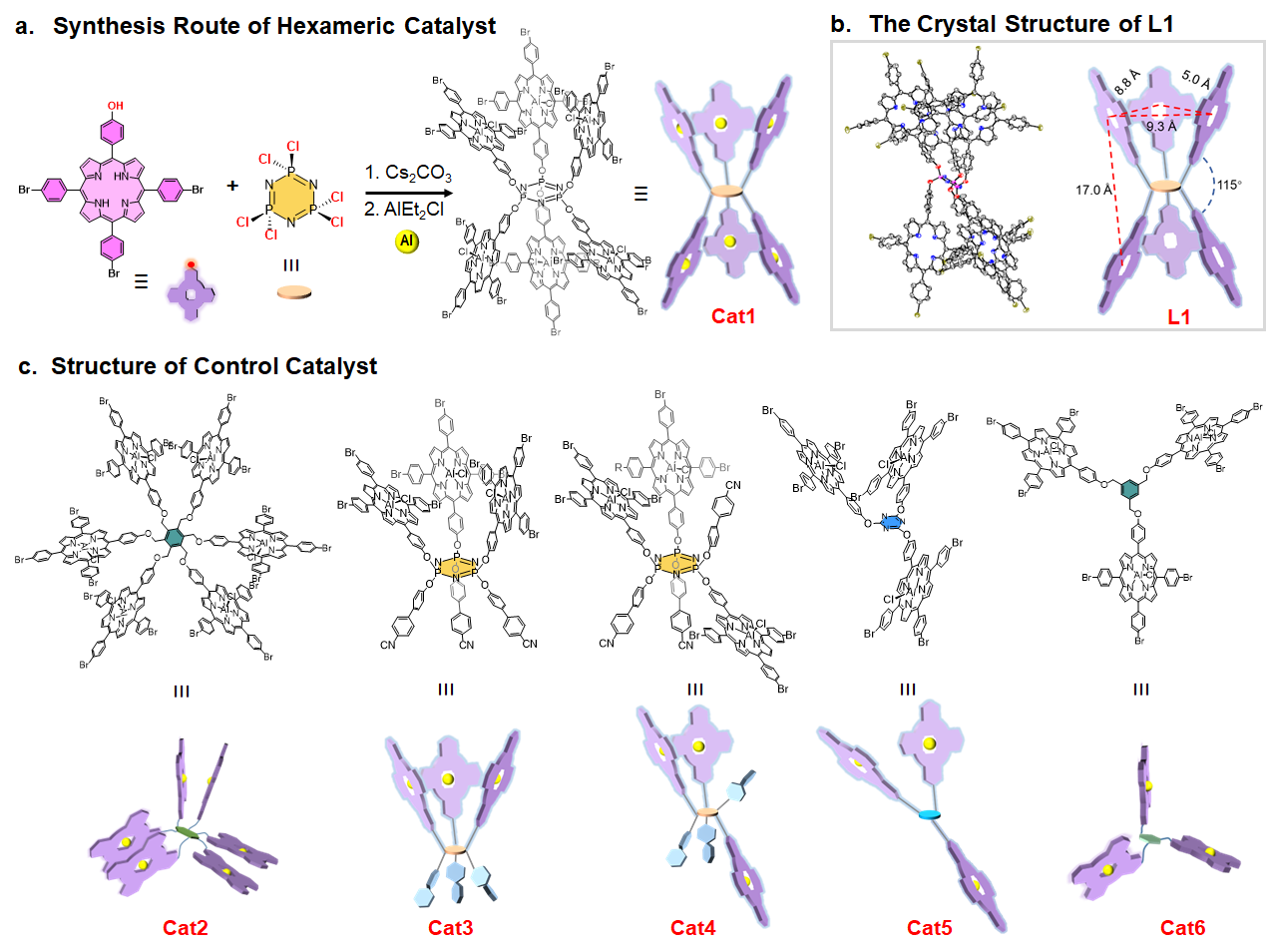
Figure 2. (a) Synthetic route, (b) crystal structure, and (c) structures of a series of control catalysts for the extremozyme-inspired hexanuclear aluminum porphyrin catalyst
To elucidate the key structural factors of the enzyme-mimetic catalyst, the researchers further constructed a complete double-trimer (Cat1), isolated dimer (Cat2), single-side complete trimer (Cat3), disrupted trimer (Cat4), partially aggregated (Cat5), and highly dispersed configurations (Cat6). The polymerization results showed a clear activity gradient: Cat1 and Cat3, which possess complete trigonal pyramidal cavities, exhibited the highest activity; Cat4 and Cat5 showed intermediate activity; while Cat2 and Cat6, which cannot form effective trimeric structures, showed the lowest activity. This indicates that the complete trigonal pyramidal trimeric cavity is key to achieving efficient multi-site cooperation.
The extremozyme-inspired catalyst achieved performance breakthroughs in propylene oxide homopolymerization and its copolymerization with phthalic anhydride and carbon dioxide. For propylene oxide homopolymerization, the maximum turnover frequency (TOF) reached 8.1×10⁵ h⁻¹, with Mn up to 1210 kg mol⁻¹, and effective polymerization was still achievable at 0.5 ppm loading. For propylene oxide/phthalic anhydride copolymerization, the maximum TOF reached 3.54×10⁴ h⁻¹, obtaining polymers with Mn of 140.8 kg mol⁻¹ at 1.34 ppm aluminum loading. For propylene oxide/CO₂ copolymerization at 130°C, the TOF reached 1.23×10⁵ h⁻¹, obtaining polycarbonate-polyether copolymers with Mn exceeding 800 kg mol⁻¹ at 2.0 ppm aluminum loading, exhibiting pressure-sensitive adhesive properties without the need for tackifiers.
This work extends biomimetic catalyst design from mimicking single active sites or local catalytic pockets to the structural translation of higher-order organization of extremozymes. This concept is not only applicable to polymerization catalysis but also provides a universal molecular design strategy for other catalytic processes involving multi-substrate activation, sequential reactions, or operation under harsh conditions.


 Address: No. 5625 Renmin Street Changchun City Jilin Province P.R. China
 Tel: 86-0431-85687300