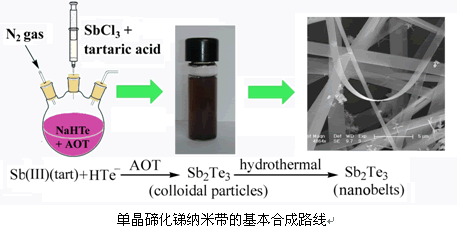
With the rapid improvement of nanomaterials science, nanobelts using various materials have been consecutively fabricated due to their distinctive geometries, novel physical and chemical properties, and potential applications in numerous areas. However, no studies have been reported on the preparation of semiconducting tellurides nanobelts to date, although their preparation is strongly desired. Antimony telluride (Sb2Te3) is a kind of thermoelectric materials with the high figure of merit (ZT). Both theoretical prediction and experimental investigation have suggested nanostructuring the thermoelectric materials can be considered as a successful strategy to gain factorial enhancements in ZT value. Therefore, developing a simple and controllable method to fabricate low-dimensional Sb2Te3 nanostructures is also significant in the study of functional materials.
With the supports of National Natural Science Foundation, Department of Science and Technology, and Chinese Academy of Science, Prof. Hongjie Zhang’ group in Key Laboratory of Rare Earth Chemistry and Physics, Changchun Institute of Applied Chemistry, Chinese Academy of Sciences have made an important breakthrough in the development of the synthesis of one-dimensional (1D) Sb2Te3 nanostructures. This work has recently been published in J. Am. Chem. Soc. (2006, 128, 16490-16491).
The surfactant-assisted hydrothermal processes have extraordinary ability in the fabrication of the 1D nanostructures. In addition, the method has also various advantages, such as simple procedure, easy control, green, uniform and good crystalline products. However, using this excellence method to fabricate Telluride nanostructures hasn’t been realized because of some difficulties, such as the selection of Te source and insolubility of raw materials.
Prof. Hongjie Zhang et al. obtained eventually single-crystalline Sb2Te3 nanobelts for the first time after they improved the hydrothermal processes and overcame above difficulties. They selected the NaHTe solution under N2 protective gas as Te source, and use tartaric acid to make SbCl3 completely dissolve in water because they can form the diffluent complex. The ionic surfactant AOT acted as the shape controller in the synthetic process. This work could be applied to obtain other low-dimensional semiconducting telluride nanostructures. Optimizations of the thermoelectric transport properties through assemble or doping of the Sb2Te3 nanobelts may lead to novel thermoelectric materials and devices for applications. The reviewers thought congruously that this work was a significant contribution to the material science. |