|
Supported by the Hundred People Program from the Chinese Academy of Sciences, Distinguished Young Scholar Fund and NSFC, Professor Xiaogang Qu and his group have been focused on the nucleic acids sequence recognition, conformational transition and their functions. Recently, they have made significant progress in this field. Their latest results on the interactions of carbon nanotubes with human telomeric DNA were published in PNAS, 2006, 103, 19658-19663. This work has been selected as “Top 100 Gene therapy publications for 2006”, News comments: on January 3, 2007 Institute of Physics Publishinghttp://nanotechweb.org/articles/news/
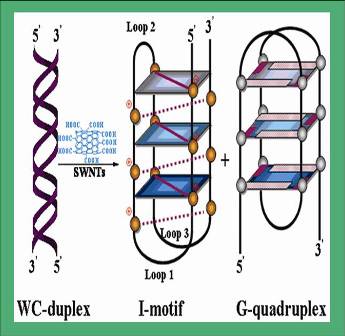
Human telomeric DNA has been considered related to longevity and disease such as cancer, and becomes a hot topic not only in biology but also in chemistry and medicine. They found that carboxyl-modified single-walled carbon nanotubes (SWNTs) significantly stabilized human telomeric C-rich strand but not G-rich strand. Further studies showed that carbon nanotubes can inhibit DNA duplex association and selectively induce human telomeric i-motif DNA formation. The stabilization of human telomeric DNA can inhibit telomerase activity, interrupt telomeric DNA synthesis and destroy indefinite proliferation of tumor cells. Therefore, therapeutic targeting of telomerase activity has been considered a promising approach for cancer therapy. It requires designing, synthesizing and screening molecules that selectively stabilize quadruplex DNA. Several small molecules have been shown to efficiently inhibit telomerase activity through the stabilization of G-quadruplex DNA. SWNTs have potential applications ranging from gene therapy to novel drug delivery to membrane separation. Selectively stabilization of human telomeric i-motif DNA by SWNTs provides a new insight to its biological and medical applications. This work was based on their studies on the interactions between SWNTs and double-stranded DNA (Nucleic Acids Res. 2006, 34, 3670-3676). They reported that SWNTs could destabilize double-stranded and triplex DNA and induce a sequence-dependent B-A DNA transition, deciphering why carbon nanotubes can cause DNA condensation. Further studies showed that SWNTs bound to the DNA major groove, in accordance with the simulation results.
Z-DNA is not a stable feature of the double helix in vivo. It is a transient structure that is occasionally induced in transcription process. Recent studies indicate that Z-DNA is correlated to human disease. Therefore, probing this transient structure is of great interest. They found that the metal natural amino acid complex, Eu-ASp complex can convert B-DNA to Z-DNA under the low salt condition at physiological temperature. Like RNA polymerase, the complex induced B-Z transition is reversible. The unique spectral characteristics make it possible as a probe to study the biological function of left-handed DNA. (Biophysical J. 2006, 90, 3203-3207); Europium–L-valine complex facilitated the self-structuring of single-stranded nucleic acids, polydA and polyrA and may regulate gene replication and transcription. There are few ligands reported selectively binding to single-stranded nucleic acids and targeting to human RNA polymerase (PAP). This work opens a new avenue to design and synthesize ligands with single-stranded nucleic acids selectivity (FEBS Lett. 2006, 580, 3726-3730).
Several factors can influence the interactions of drug molecules and DNA, such as drug size, stereochemistry; solution conditions; DNA sequence and conformation. They found that water molecules participated to this process; DNA flanking sequence induced enthalpy-entropy compensation for drug binding; the flanking sequence could also modulate the long-range DNA-mediated charge transport. For (AA)n or (AT)n species of the same length, the charge transport rate was related to the DNA free energy, and enhanced with increase in DNA stability. Series results have been published in Biochemistry (2006, 45, 13543-13550; 2003, 42, 11960-11967).
|



