


Research Progress
Significant Progress in Chiral Gold Nanocrystals and Chiroptical Response Modulation
The Changchun Institute of Applied Chemistry, Chinese Academy of Sciences (CIAC, CAS) has achieved significant progress in the precise structural control of chiral metal nanocrystals and the modulation of their chiroptical properties. The team led by Niu Wenxin has developed a surfactant-layer engineering-based regulation strategy that, without altering the configuration of the chiral inducer, achieves controllable switching of the growth pathway of helicoid gold nanocrystals and directional reversal of their chiroptical response, providing new research insights for the design and control of chiral plasmonic nanomaterials. The related research results were published in the prestigious international journal Journal of the American Chemical Society under the title "Surfactant-Layer Engineering Enables Growth Pathway Switching and Reversal of Chiroptical Activity in Helicoid Gold Nanocrystals."
In chiral nanostructures, the coupling relationship between geometric configuration and light-matter interactions is a critical factor determining their optical response. Helicoid gold nanocrystals, with their three-dimensional asymmetric structures capable of constraining plasmonic oscillation trajectories, are considered a typical model system for studying chiral plasmonic effects. However, existing synthesis methods for helicoid gold nanocrystals typically rely on the enantiomeric configuration of chiral inducers to control their chiral morphology and optical signals, commonly facing challenges such as limited sources of chiral molecules, high costs, and difficulty in achieving chiroptical signal reversal. Therefore, how to achieve controllable modulation of the chiral structure and chiroptical response of helicoid gold nanocrystals while maintaining the configuration of the chiral inducer unchanged has become a core scientific issue requiring urgent resolution.
To address this challenge, the research team introduced aromatic molecules such as 5-bromosalicylic acid as interfacial regulation factors into the cysteine-induced seed-mediated growth system. These aromatic molecules can intercalate into the surfactant bilayer structure on the gold nanocrystal surface, synergistically controlling interfacial ion adsorption and micelle packing behavior, thereby significantly altering the relative growth rates along the ⟨100⟩ and ⟨111⟩ crystallographic directions and inducing the gradual formation of surface concave structures. Under these effects, the geometric configuration of the helicoid gold nanocrystals gradually transformed from the original C₄-type pinwheel structure to a C₃-type propeller structure, and their circular dichroism (CD) signal underwent complete reversal, with the g-factor inverting from −0.14 to +0.09, indicating the achievement of synergistic reversal control of both chiral structure and chiroptical response. Further structural characterization and theoretical simulation studies revealed that this chiroptical reversal originates from changes in the relative contributions of different chiral centers to the overall structure. In the original helicoid gold nanocrystals, the C₄-type chiral center dominates in both geometric dimensions and optical response; whereas under aromatic molecule regulation, anisotropic growth along the ⟨100⟩ direction and enhanced surface concave structures cause the C₃-type chiral center to gradually become the dominant contributor, driving the reversal of the overall chiroptical signal. Simultaneously, the formation of surface concave structures significantly enhances local structural asymmetry, further amplifying the chiroptical response intensity.
This work not only developed a flexible, scalable chiral nanocrystal synthesis strategy but also established structure-property relationships between surfactant interface engineering, anisotropic growth, and chiroptical response, providing new ideas for the precise design and performance modulation of chiral plasmonic materials. This method exhibits broad chemical compatibility, applicable to various aromatic molecules and chiral inducers, and enables size modulation through seed quantity adjustment, demonstrating good universality and application potential that will advance functional material innovation in chiral sensing, asymmetric catalysis, and spin optoelectronics.
The research results are published in Journal of the American Chemical Society:
https://pubs.acs.org/doi/10.1021/jacs.5c20595
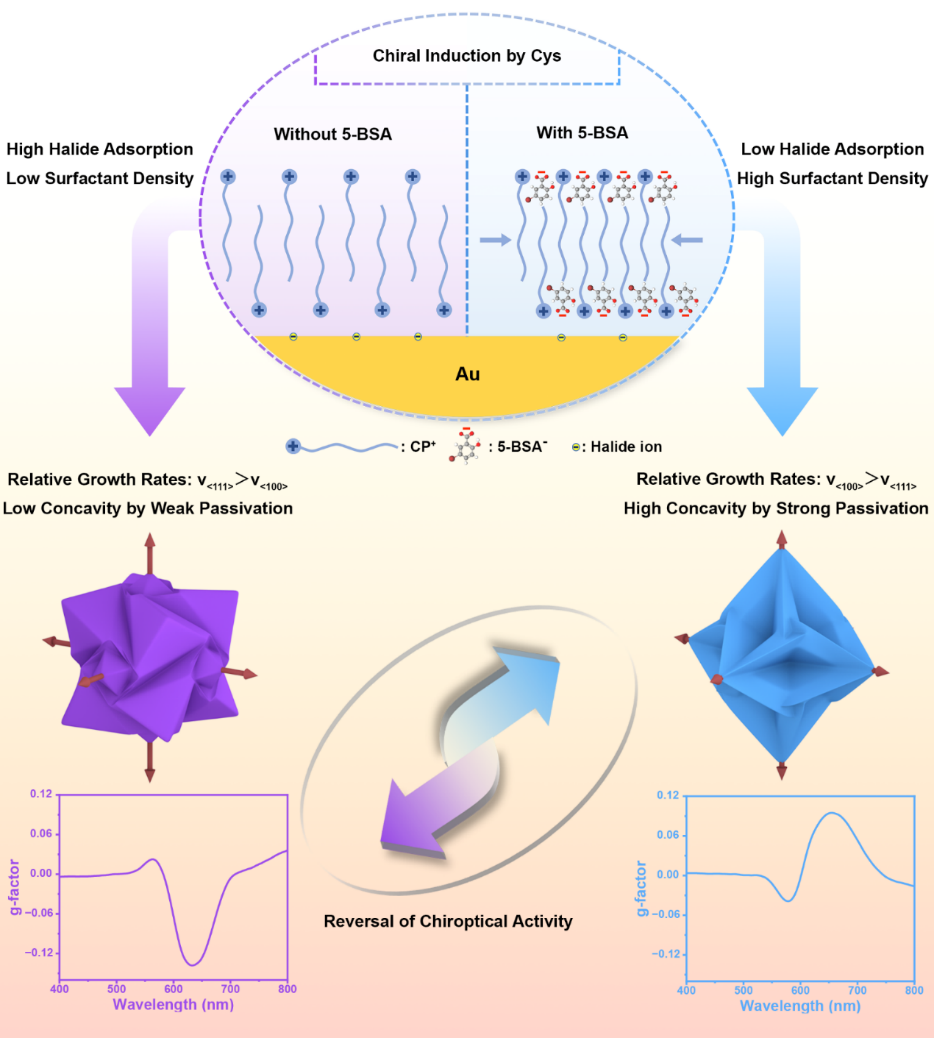
Figure 1. Schematic illustration of different growth pathways and chiroptical activity reversal of helicoid gold nanocrystals with and without 5-BSA.

 Address: No. 5625 Renmin Street Changchun City Jilin Province P.R. China
 Tel: 86-0431-85687300