


Research Progress
Significant Breakthrough in Dynamic Monitoring of Neurochemical Signals
The Changchun Institute of Applied Chemistry, Chinese Academy of Sciences (CIAC, CAS) has achieved significant progress in the precise dynamic monitoring of neurochemical signals during the progression of glioblastoma. Dr. Liu Chen from the research team led by Researcher Lu Lehui, in collaboration with Professor Liu Yanlan from Hunan University, developed an implantable neural probe based on a highly selective sensing platform. Combined with the spatial resolution of magnetic resonance imaging (MRI) and the functional analysis capability of electroencephalographic recording (EEG), this platform enabled in situ, long-term monitoring of dopamine (DA) dynamics in glioblastoma (GBM)-infiltrated brain regions. The related research results were published in the prestigious international chemistry journal Journal of the American Chemical Society under the title "Carbon-Coordinated Cobalt Electrochemical Nanoplatform Enables in Vivo Selective Monitoring of Neurochemical Dysregulation in Glioblastoma-Infiltrated Brain."
Implantable neural probes, as core front-end components of brain-computer interfaces (BCIs), have their signal capture capability directly determining the precision and reliability of brain-computer interaction. However, when confronted with glioblastoma—a fatal primary malignant brain tumor—implantable BCIs face severe challenges: the complex chemical composition of the tumor microenvironment (high concentrations of ascorbic acid, oxidative stress, and weak acidity) creates signal interference, while the infiltrative growth of the tumor imposes stringent requirements for spatial localization. These factors collectively constitute the core bottleneck for extending BCI technology to cancer neuroscience.
To address these issues, the research team designed implantable neural probes for the dynamic, selective monitoring of dopamine in glioblastoma. To achieve spatially precise implantation, the team introduced MRI technology: through T2-weighted MRI imaging, they dynamically tracked the infiltration boundary of tumors into the striatum on days 4, 7, and 14 after inoculation of GL261 glioma cells in mice, using this as guidance to precisely implant CoCx@C-based neural probes into the brain (Figure 1a-c). Based on this positioning, the probe achieved monitoring of dopamine dynamics at different disease stages in glioma model mice. The results showed that as the tumor progressed, dopamine levels in the mouse striatum decreased progressively, with motor function impairment gradually worsening in the balance beam walking test, validating the probe's ability to track neurochemical dynamics under pathological conditions (Figure 1d-e). Furthermore, the research team simultaneously collected EEG signals from the striatum of both normal and glioma-bearing mice (Figure 1f-h). Compared to the stable rhythms presented by control subjects, glioma mice exhibited irregular abnormal signal oscillations, a finding that directly associates neurochemical signals with electrical abnormalities at the in vivo level, achieving simultaneous sensing and analysis of neural electrical and chemical signals.
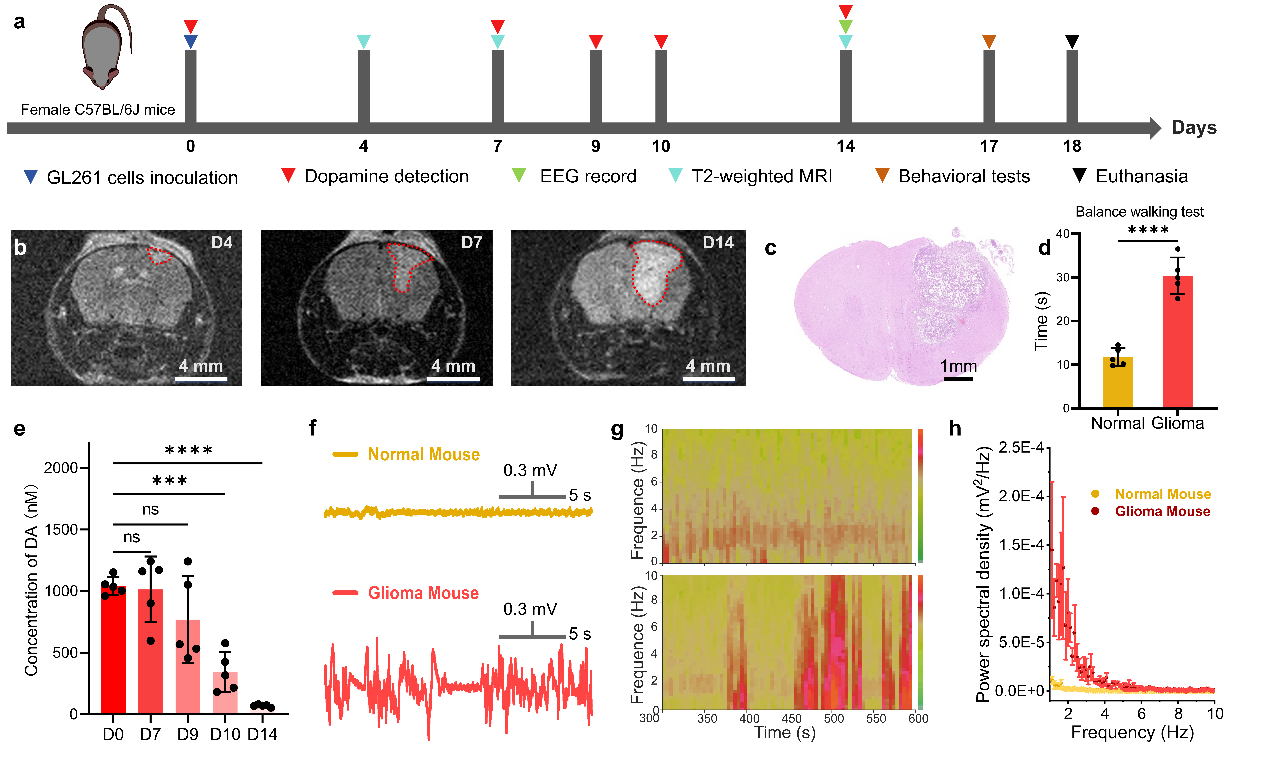
Figure 1. In situ monitoring of dopamine dynamics and neural electrical activity analysis in glioblastoma-infiltrated brain regions.
This study, through the development of novel implantable neural probes, achieved highly selective and highly stable monitoring of the neurotransmitter DA in the brain tumor microenvironment. More importantly, this work integrated high-performance implantable neural probes with MRI and EEG signal acquisition technologies, establishing a multi-dimensional research paradigm from the molecular level (dopamine dynamics), tissue level (MRI-guided tumor infiltration regions), to neural circuit level (EEG-revealed electrical activity abnormalities), providing a new technical platform for elucidating tumor-neuron interaction mechanisms and developing neuroprotective treatment strategies.
The research results are published in Journal of the American Chemical Society:
https://doi.org/10.1021/jacs.5c14261


 Address: No. 5625 Renmin Street Changchun City Jilin Province P.R. China
 Tel: 86-0431-85687300