


Research Progress
Significant Progress in Anion-Binding Catalysis for Controlled Synthesis of Poly(1,3-dioxolane)
The Changchun Institute of Applied Chemistry, Chinese Academy of Sciences (CIAC, CAS) has achieved significant progress in the controlled synthesis of poly(1,3-dioxolane) (PDXL) via anion-binding catalysis. The research team led by Researcher Tao Youhua established a novel strategy for anion-binding catalytic cationic ring-opening polymerization, successfully achieving precise controlled synthesis of PDXL ranging from low molecular weight telechelic polymers to high molecular weight thermoplastic materials, resolving an eighty-year synthetic challenge associated with this classic polyacetal material. The related research results were published in the prestigious international chemistry journal Journal of the American Chemical Society under the title "Enabling Controlled Synthesis of Poly(1,3-dioxolane) by Anion-Binding Catalytic Cationic Ring-Opening Polymerization."
PDXL is a promising class of chemically recyclable thermoplastic materials, with monomers potentially sourced from inexpensive and abundantly available coal chemical feedstocks—ethylene glycol and formaldehyde—and the material itself possesses excellent physical properties. Despite more than eighty years of related research, synthesizing PDXL with high chain-end fidelity, controllable molecular weight, and well-defined structure remains a challenging task. This is mainly attributed to the high reactivity of living chain ends, which readily triggers various side reactions during polymerization: first, intramolecular cyclization leading to uncontrolled polymer end groups with coexistence of cyclic and linear products; second, frequent intermolecular acetal exchange reactions broadening the dispersity of polymerization products; and third, facile chain transfer of cationic active centers to minor impurities such as alcohols or water, making it difficult to increase product molecular weight. Therefore, developing a catalytic system capable of selectively obtaining telechelic PDXL and high molecular weight PDXL under mild conditions is of great significance.
To address these challenges, the research team proposed a selenocyclophosphamide catalyst and silyl initiator (Me₃SiX, X = I or OTf)-based anion-binding catalytic cationic ring-opening polymerization (CROP) system, achieving for the first time efficient and highly selective preparation of both low molecular weight telechelic PDXL and high molecular weight PDXL (Figure 1). Experimental and mechanistic studies revealed the key roles of each component in the system: (1) the catalyst utilizes anion-binding interactions to reversibly abstract and bind anions from dormant covalent precursors, generating active oxonium ions that undergo electrophilic addition with DXL monomers; (2) the Me₃SiX initiator, in addition to initiation, serves as a protecting group for the α-chain end, efficiently and completely hydrolyzing to hydroxyl groups upon quenching, thus ensuring telechelic chain-end fidelity; (3) the choice of counter anion (X⁻) determines the instantaneous concentration of active species in the dormant-active equilibrium. Specifically, utilizing the low leaving ability of I⁻ significantly shifts the equilibrium to the left, maintaining extremely low instantaneous concentrations of active species, thereby effectively suppressing cyclization side reactions and precisely synthesizing low molecular weight dihydroxyl telechelic PDXL; whereas utilizing the high leaving ability of OTf⁻ increases the instantaneous concentration of active species in the system, substantially enhancing polymerization rate. Combined with the action of a proton scavenger, this enables the preparation of high molecular weight PDXL exceeding 500 grams on a laboratory scale. In summary, this method features controllable polymerization, mild conditions, scalable synthesis, and catalyst recyclability, holding promise for promoting large-scale applications of PDXL-based materials. More broadly, this strategy marks a significant advance in the field of controlled CROP, and its principles are applicable not only to cyclic acetals but can be directly applied to various monomers including tetrahydrofuran, cyclic siloxanes, and oxazolines, thereby opening new avenues for synthesizing diverse functional and sustainable polymers.
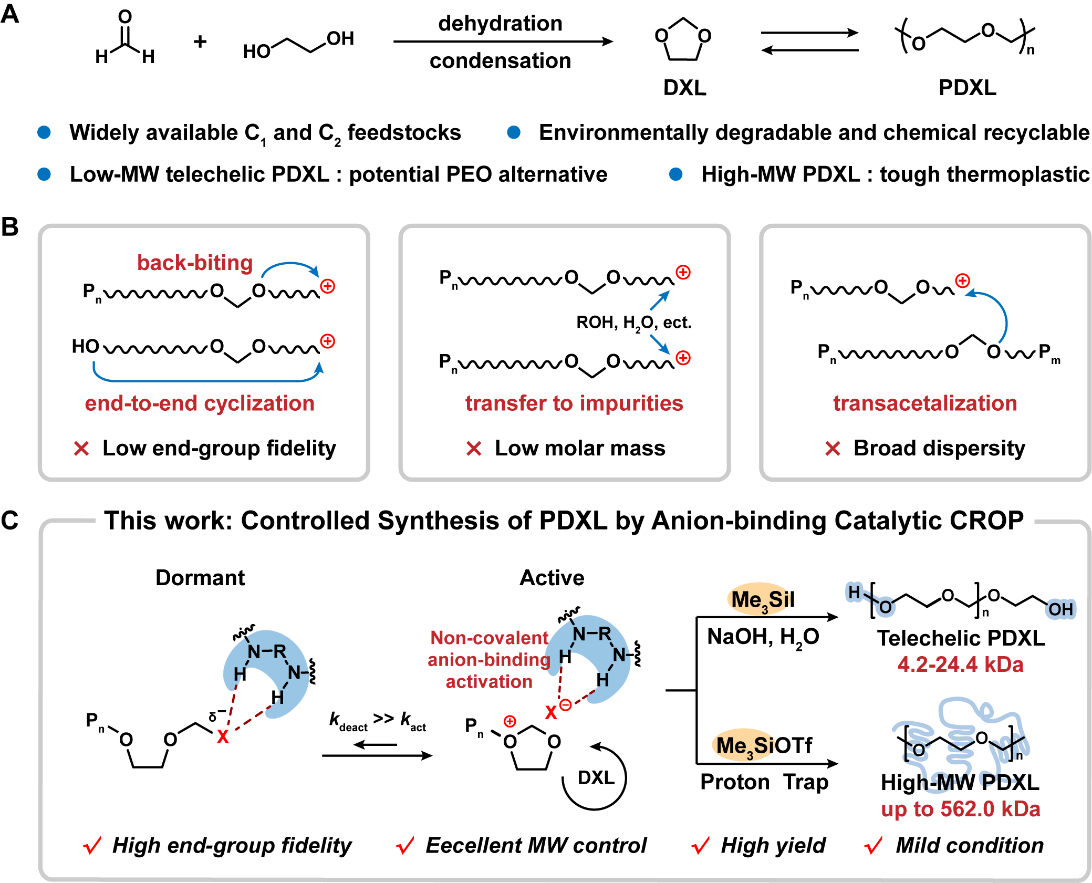
Figure 1. Anion-binding catalysis enabling controlled synthesis of poly(1,3-dioxolane).
This work represents one of the latest advances by the team in non-covalent catalytic polymerization methodology. In recent years, the team led by Researcher Tao Youhua at CIAC has been dedicated to developing new polymerization methods based on non-covalent catalysis, where the catalyst activates monomers and regulates growing chain ends through non-covalent interactions. This non-covalent binding mode features smaller free energy (enthalpy) changes compared to metal coordination binding, enabling faster binding and dissociation with chain ends, thus allowing efficient and highly selective catalytic conversion under milder conditions while overcoming some unresolved challenges. Based on this catalytic polymerization concept, they developed catalytic systems from thiourea to next-generation selenocyclophosphamide scaffolds, precisely regulating polymer chain ends, and separately constructed active anionic ring-opening polymerization of amino acid cyclic monomers under green and mild conditions (Angew. Chem. Int. Ed. 2021, 60, 6003; J. Am. Chem. Soc. 2022, 144, 23622) and active cationic polymerization of electron-rich vinyl ether monomers (Nature Synthesis 2022, 1, 815; Angew. Chem. Int. Ed. 2023, 62, e202303237; Angew. Chem. Int. Ed. 2025, 64, e202425178; Nat. Commun. 2025, 16, 4636). This work further extends this catalytic concept to the cationic ring-opening polymerization of heterocyclic monomers, achieving precise polymer synthesis. The above series of studies demonstrates that utilizing non-covalent interactions to catalyze challenging ionic polymerizations represents a promising new research direction in polymerization catalysis, which will undoubtedly play an important role in promoting the sustainable development of polymer science and its industries.
The research results are published in Journal of the American Chemical Society:
https://pubs.acs.org/doi/full/10.1021/jacs.5c18989


 Address: No. 5625 Renmin Street Changchun City Jilin Province P.R. China
 Tel: 86-0431-85687300