


Research Progress
Significant Progress in Rational Design of Metal Oxide/MOF Functional Materials and Multimodal Sensing Applications
The Changchun Institute of Applied Chemistry, Chinese Academy of Sciences (CIAC, CAS) has achieved significant progress in the rational design of metal oxide/metal-organic framework (MOF) functional materials and their multimodal sensing applications. The team led by Academician Yang Xiurong and Researcher Wang Dewen successfully prepared MOF-confined Co-doped IrOₓ composites (CoIrOₓ/CoIr-MOFs) via in situ confinement, which exhibit multi-enzyme-like (oxidase, peroxidase, and laccase) activities and can directly catalyze the generation of reactive oxygen species (ROS) from oxygen or hydrogen peroxide, enabling a trimodal sensing platform with efficient detection performance for glutathione. The related research results were published in the prestigious international journal ACS Nano under the title "In Situ Domain-Confined CoIrOₓ Clusters within MOFs: Efficient Artificial Nanozymes for Multimodal Sensing."
Nanozymes are a class of nanomaterials with enzyme-like catalytic activity. Among them, metal oxide (MO) nanozymes have attracted widespread attention due to their high stability and low cytotoxicity; however, insufficient regulation of particle size and intermediate adsorption energy leads to low active site density and sluggish reaction kinetics. Precisely controlling MO growth and modulating the adsorption behavior of active sites remain key challenges in developing high-performance nanozymes. Transition metal-based MOFs can effectively control MO size and spatial distribution through in situ confinement effects, while metal nodes provide inherent catalytic activity, increasing the number and accessibility of active sites. Compared to single-component systems, MOs/MOFs exhibit enhanced catalytic performance through synergistic effects. Currently, most MOs/MOFs heterojunctions rely on post-synthesis modification strategies that are cumbersome. One-pot methods, through co-precursor approaches and regulation of nucleation rates, can simply and rapidly produce MOs/MOFs nanozymes. Additionally, transition metals with unoccupied 3d orbitals, beyond participating in MOF framework construction, can potentially be incorporated into MOs to optimize electronic structure and adsorption energy for key intermediates, thereby enhancing catalytic performance. Although a few one-pot methods have been developed for MOs/MOFs preparation, none have achieved transition metal doping, and control of MOs/MOFs size and uniformity remains difficult. Therefore, promoting effective capture and stabilization of formed MOs by MOFs, as well as MOF nucleation and growth on their surfaces, is of critical importance.
This study innovatively proposed a one-pot strategy that simultaneously achieves IrOₓ cluster nucleation, MOF formation, and cobalt (Co) doping, forming MOF-confined Co-doped IrOₓ composites (CoIrOₓ/CoIr-MOFs) (Figure 1). MOF nanosheets formed on the surface of preferentially nucleated CoIrOₓ, suppressing its excessive growth and aggregation, with ultra-small CoIrOₓ uniformly confined in the interlayer region and forming tight interfaces with CoIr-MOFs. Co doping into the IrOₓ lattice reduced the adsorption energy of OH* intermediates, lowered the overpotential and rate-determining step energy barrier for oxygen reduction reactions, and enhanced substrate affinity at catalytic sites. CoIrOₓ/CoIr-MOFs, under synergistic regulation of in situ confinement and cobalt doping, exhibited outstanding catalytic performance, directly catalyzing the generation of reactive oxygen species (ROS) from oxygen or hydrogen peroxide, demonstrating multi-enzyme-like (oxidase, peroxidase, and laccase) activities, thereby enabling different signal transduction pathways. The trimodal sensing platform based on CoIrOₓ/CoIr-MOFs demonstrated efficient detection performance for glutathione (Figure 2).
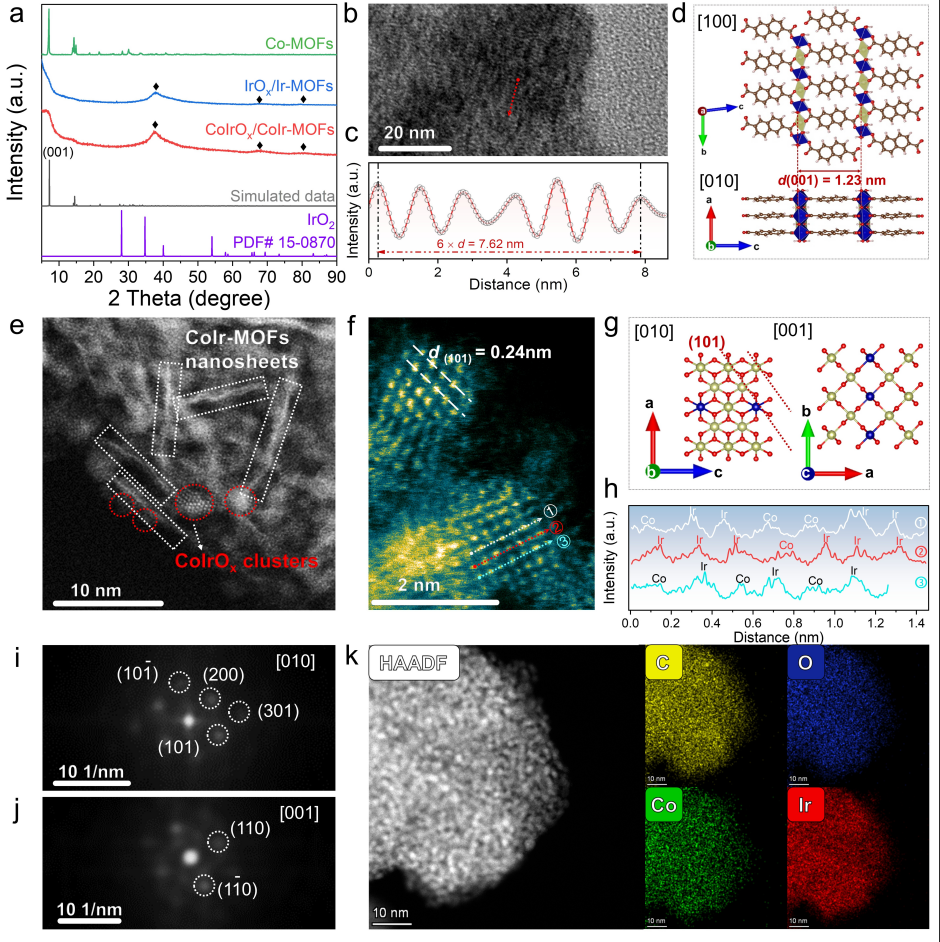
Figure 1. Structural characterization and atomic model of CoIrOₓ/CoIr-MOFs materials.
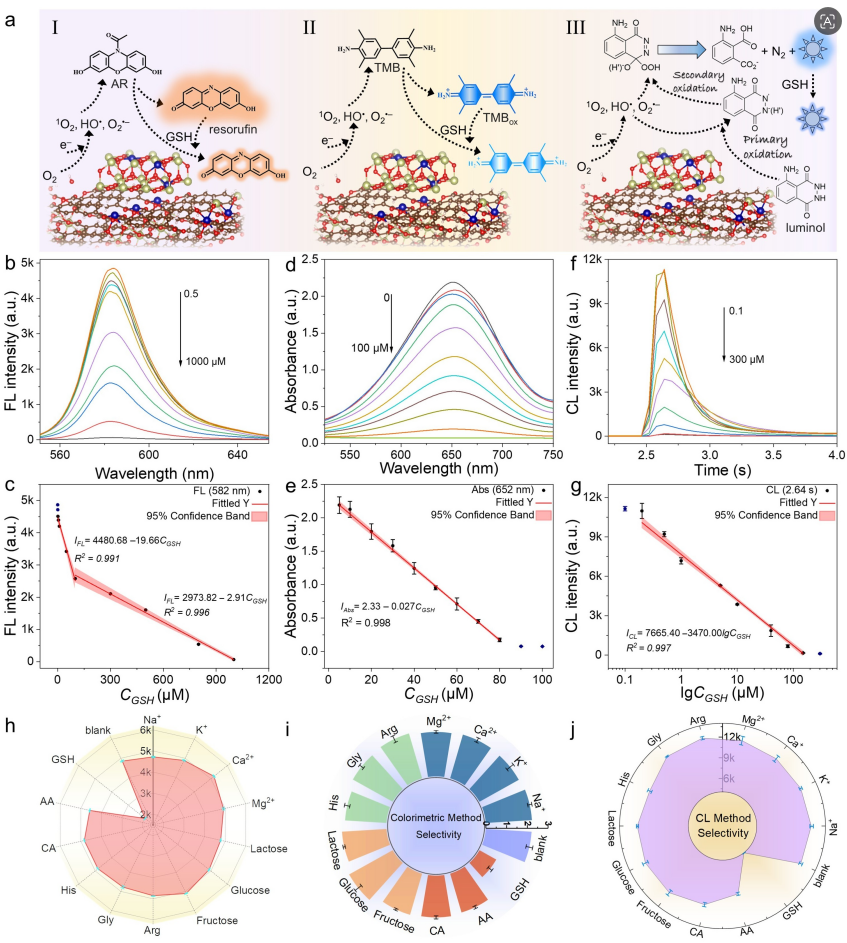
Figure 2. Schematic diagrams of fluorescence, colorimetric, and chemiluminescence modes for GSH detection catalyzed by CoIrOₓ/CoIr-MOFs.
The research results are published in ACS Nano:
https://doi.org/10.1021/acsnano.6c00731


 Address: No. 5625 Renmin Street Changchun City Jilin Province P.R. China
 Tel: 86-0431-85687300