


Research Progress
Significant Progress in Protonation Kinetics Optimization and Reaction Mechanism of Alkaline Oxygen Reduction Reaction
The Changchun Institute of Applied Chemistry, Chinese Academy of Sciences (CIAC, CAS) has achieved significant progress in optimizing protonation kinetics and exploring the reaction mechanism of alkaline oxygen reduction reactions (ORR). The research team led by Researcher Zhu Jianbing constructed a proton relay unit by synthesizing atomically dispersed FeSn dual-atom sites, which efficiently promotes water dissociation to provide protons at the adjacent position of the ORR active center, thereby accelerating ORR kinetics. The related research results were published in the prestigious international journal Journal of the American Chemical Society under the title "Proton Relay Mediated by Atomic Sn Lewis-Acidic Sites for Accelerating Oxygen Reduction Kinetics in Fe–N–C Catalysts."
Hydrogen fuel cells are core technologies for achieving zero carbon emissions and efficient energy transition. As the core cathode process in hydrogen fuel cells, the sluggish kinetics of the oxygen reduction reaction directly constrains battery energy conversion efficiency and power output. Traditional strategies have primarily focused on modulating the electronic structure of active sites while overlooking the proton transfer process at the three-phase interface. In alkaline media, the lack of hydrated protons means the reaction relies entirely on water molecules as proton sources, requiring interfacial water to activate O-H bonds and deliver protons to oxygen intermediates, thereby introducing a high energy barrier. Interfacial water, due to weak polarization effects, struggles to weaken O-H bonds, and the dynamic fluctuation of water configurations near active sites prevents formation of stably dissociable configurations. Furthermore, the electric field and cations in the electrical double layer further exacerbate the difficulty of proton supply. Existing interfacial water engineering approaches primarily focus on the overall properties of hydrogen bond networks, making it difficult to provide activated water for sustained proton supply at the atomic scale. Therefore, there is an urgent need to construct atomic-scale adjacent cooperative sites that can activate and dissociate water molecules while directly supplying protons to adsorbed oxygen intermediates, thereby accelerating proton-coupled electron transfer processes.
This study developed the FeSn-N-C dual-atom catalyst to achieve the above solution. As is well known, the p-block metal Sn, with its Lewis acidity, endows it with strong interactions with interfacial water, polarizing the O-H bond and thereby promoting the dissociation process; simultaneously, compared to iron, Sn has much lower intrinsic competitiveness in adsorbing oxygen intermediates. Based on this principle, a tin site was introduced near the Fe-N₄ center to construct a functionally independent dual-atom site where Fe controls the adsorption/activation of oxygen intermediates while Sn activates the O-H bonds of interfacial water, achieving short-range proton transfer to iron-adsorbed oxygen intermediates, thereby eliminating the sluggish protonation kinetics caused by the difficulty of water molecule dissociation near Fe sites. The superiority of this strategy was verified through electrochemical performance evaluation. The resulting FeSn-N-C catalyst exhibited a half-wave potential of 0.940 V (vs. RHE) in 0.1 M KOH, 39 mV higher than commercial Pt/C. At the fuel cell level, peak power densities of 1.01 W cm⁻² (H₂-O₂) and 0.71 W cm⁻² (H₂-air) were achieved, and the FeSn-N-C cathode could reach a current density of 0.160 A cm⁻² at 0.90 V_iR-free, representing one of the best reported performances for PGM-free AEMFC cathodes.
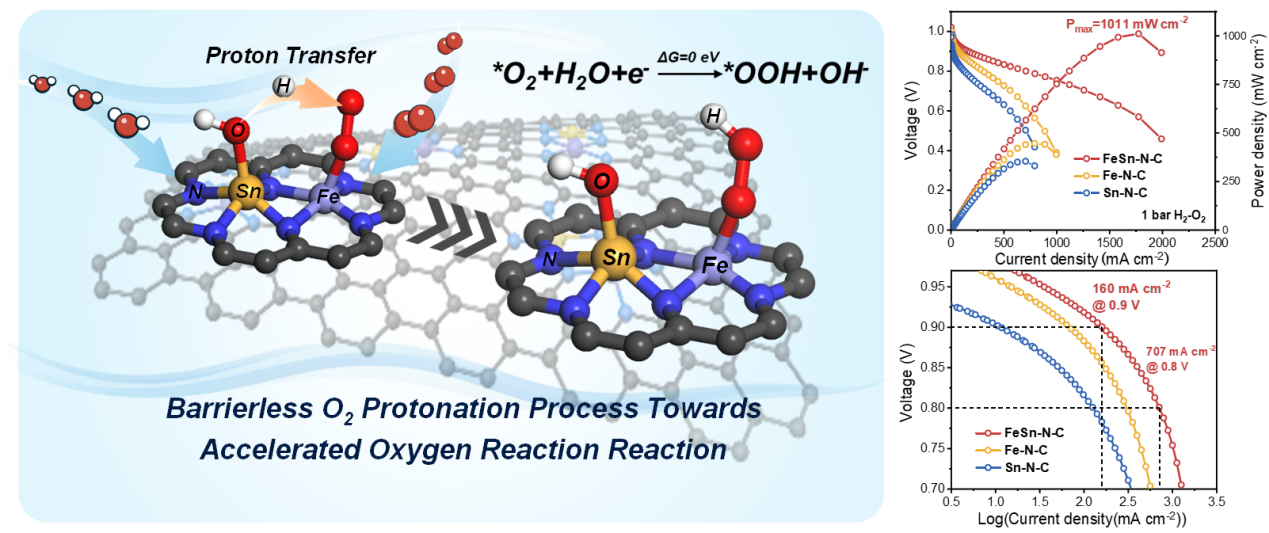
Figure 1. FeSn-N-C oxygen reduction reaction proton relay mechanism diagram (left) and FeSn-N-C fuel cell application performance diagram (right).
To precisely quantify the enhancement of proton relay unit Sn on the protonation kinetics of oxygen intermediates on Fe, the research team conducted molecular dynamics simulations and energy barrier calculations for the proton transfer processes of FeSn-N-C and Sn-free Fe-N-C. The results showed that for the OH* protonation process, the energy barrier on FeSn-N-C was reduced from 0.52 eV on Fe-N-C to 0.33 eV. Notably, for the O₂ protonation process, compared to the 0.46 eV barrier on Fe-N-C, FeSn-N-C exhibited no energy barrier, a result that powerfully demonstrates the critical role of the proton relay unit Sn in enhancing the protonation kinetics of oxygen intermediates on Fe. This atomic-scale cooperative site relay effect provides new insights for subsequent oxygen reduction research.
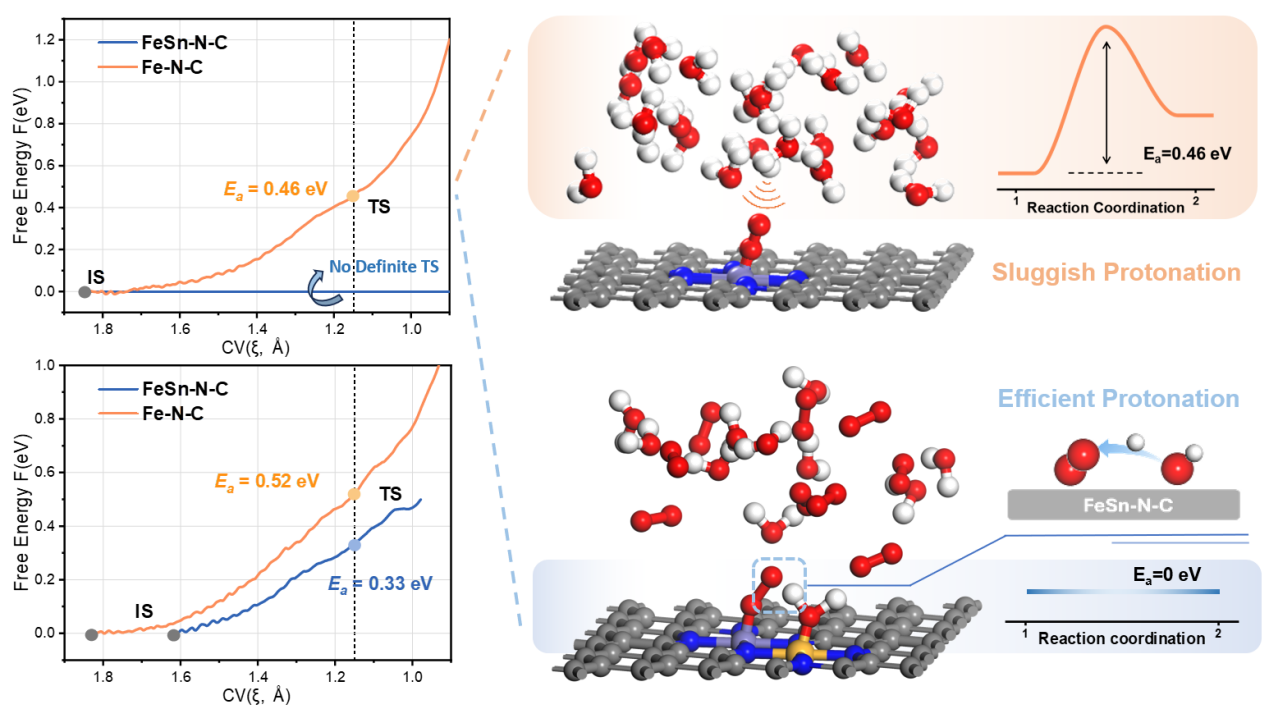
Figure 2. Protonation energy barriers for O₂ (upper left) and *OH (lower left) in the oxygen reduction reaction on FeSn-N-C and Fe-N-C.
The research results are published in Journal of the American Chemical Society:
http://pubs.acs.org/doi/abs/10.1021/jacs.6c01888


 Address: No. 5625 Renmin Street Changchun City Jilin Province P.R. China
 Tel: 86-0431-85687300