
Research Progress
Significant Progress in Oxygen Defect Functional Regulation of High-Entropy Oxide Catalysts and Reverse Water-Gas Shift Reaction Mechanism
The Changchun Institute of Applied Chemistry, Chinese Academy of Sciences (CIAC, CAS) has achieved significant progress in the functional regulation of oxygen defects in high-entropy oxide catalysts and the exploration of the reverse water-gas shift (RWGS) reaction mechanism. The team led by Zhang Hongjie, Song Shuyan, and Wang Xiao at CIAC, in collaboration with Wang Jing's team at Yanshan University, successfully constructed a spinel@rock-salt core-shell structured catalyst by introducing Cr to induce structural evolution of high-entropy oxides, achieving precise regulation of oxygen defect functions and elucidating the competition mechanism between the associative pathway and redox pathway in the RWGS reaction, substantially enhancing CO₂ hydrogenation to CO catalytic performance. The related research results were published in the prestigious international journal Journal of the American Chemical Society under the title "Functionally Regulating the Oxygen Defects in High-Entropy Oxide Catalysts for Reverse Water-Gas Shift Conversion."
The greenhouse effect caused by excessive CO₂ emissions is becoming increasingly severe. The selective hydrogenation conversion of CO₂ to high-value chemicals is one of the key approaches to alleviating energy and environmental issues. Surface oxygen defects are recognized as critical active sites for the RWGS reaction. Traditional research has primarily focused on increasing oxygen defect concentration but is limited by the thermodynamically allowed upper limit. How to regulate the function of oxygen defects at the atomic scale rather than merely increasing their quantity, and to clarify the intrinsic relationship between associative and redox pathways, represents a major challenge in this field.
This study proposed a strategy using Cr³⁺ as a structure-directing agent to modulate the high-entropy oxide Mg₀.₂Co₀.₂Ni₀.₂Cu₀.₂Zn₀.₂O (J14) through doping. The study found that Cr introduction induced evolution from a single rock-salt phase to a spinel@rock-salt core-shell structure, reducing lattice stress and improving thermodynamic stability. The optimal catalyst J14-Cr1 achieved a CO₂ conversion rate of 28.9% (approaching the thermodynamic equilibrium conversion rate of 30%) and CO selectivity of 94.8% at a low temperature of 350°C, with a CO yield as high as 48.9 μmolCO·gcat⁻¹·s⁻¹, and maintained 90% of initial activity after 100 hours of continuous reaction, significantly outperforming the undoped J14 catalyst.
Combining quasi-in situ XPS, in situ DRIFTS, CO₂ adsorption-reduction experiments, and DFT calculations, the study for the first time confirmed the existence of two functionally distinct oxygen defects on the J14 surface: one responsible for CO₂ adsorption followed by hydrogenation (associative pathway), and the other directly catalyzing CO₂ dissociation (redox pathway). Cr³⁺ doping optimized the ratio of these two types of oxygen defects: promoting the associative pathway while suppressing the redox pathway, thereby achieving an optimal balance between the two.
This study for the first time revealed the competitive relationship between the associative and redox pathways in the RWGS reaction, proposing a completely new catalyst design concept of "functionally regulating oxygen defects" rather than "blindly increasing defect quantity." The obtained spinel@rock-salt core-shell structured high-entropy oxide catalyst achieved the highest catalytic efficiency among reported copper-based RWGS catalysts, opening new directions for surpassing the performance limits of existing CO₂ hydrogenation catalysts.
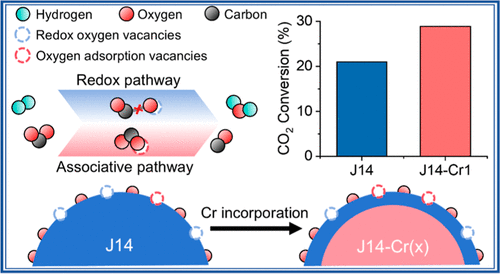
Figure 1. Schematic illustration of Cr doping promoting J14 structural and oxygen vacancy functionalization transformation.
The research results are published in Journal of the American Chemical Society:
https://pubs.acs.org/doi/10.1021/jacs.6c07924

 Address: No. 5625 Renmin Street Changchun City Jilin Province P.R. China
 Tel: 86-0431-85687300